Episode Transcript
Intro: The WellsFaber Podcast is about helping you live the life you want. WellsFaber believes that money is about more than the figures in your bank or your investment account. It's about having the confidence to thrive as you achieve your life goals, supported by a sound financial plan.
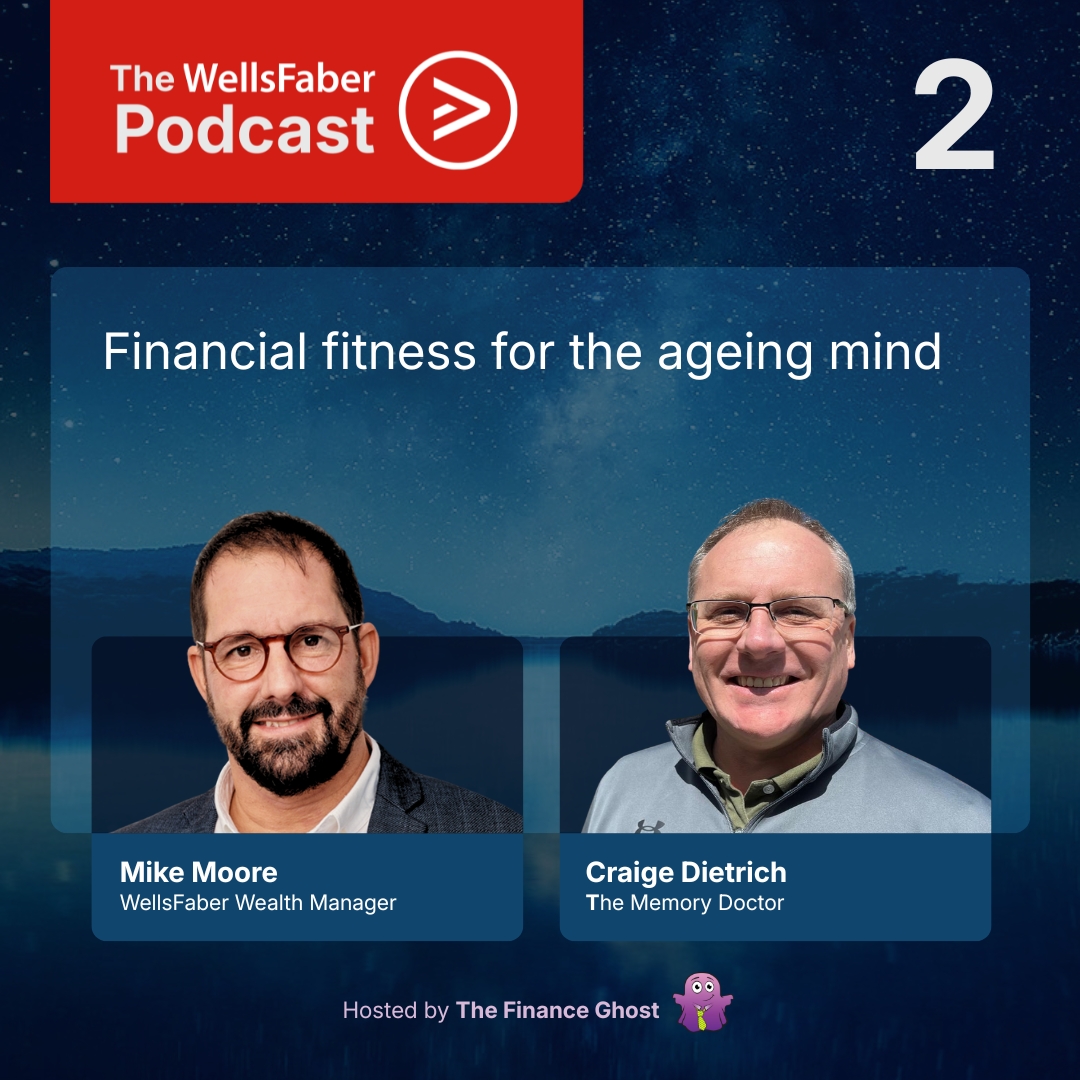
Hosted by me, the Finance Ghost, in partnership with WellsFaber, this podcast series features expert guests and insights from WellsFaber clients who have overcome challenges and unlocked key learnings in their wealth creation journey. Episode 2 features Dr. Craige Dietrich, the Memory Doc, and Mike Moore, Wealth Manager at WellsFaber.
The Finance Ghost: Welcome to the second episode of my collaboration with WellsFaber, where we are putting together some really fantastic podcasts that deal with all kinds of things about your health and wealth, effectively. Go back and check out episode 1 if you haven't done so already. It was a fantastic conversation with Dr. Michael Mol where we talked about how to lengthen your quality of life – your healthspan, not just your lifespan. Really worth listening to!
But even if you put in place all of the good stuff, we are all getting older every day, which means there's some other stuff that we inevitably need to talk about. And that's why we are here today.
To help us dig through this stuff, we have a special guest. We have Dr. Craige Dietrich, who is the Memory Doc operating out of Cape Town. He's joining us to help us understand more about the reduction in executive function that comes with old age and what this means for all of our financial affairs. And Mike Moore, he is a Wealth Manager at WellsFaber. He's joining in for this discussion because, of course, he assists clients dealing with this stuff, rather than because he's becoming forgetful.
Mike, are you starting to get to the point where you lose your keys, lose your glasses? You know, why are you on this podcast? Is it clients or is it for you?
Mike Moore: Ghost, if my family was on this podcast, they would know that I never lose anything.
The Finance Ghost: There we go. But your family's not here, so I don't believe a word of that. Craige, would your family also lie for you like that, or can you at least be truthful? Because I think we all have some memory loss challenges, don't we?
Dr Craige Dietrich: Absolutely. Every day. My kids would certainly have a lot to say about my behaviour, what I say to them and being cranky as an old man. The Aging brain unfortunately creates a whole host of problems from behaviours.
The Finance Ghost: Well, we're not going to do crankiness today, but we're definitely going to do memory. All jokes aside – Mike, this is a topic that seems to be quite close to your heart. This is obviously something that Craige deals with literally every day, professionally. You deal with it professionally too though, just with a different lens. Tell us why you wanted to cover this topic. Why is this important for you and why do you think it's important for the client base of WellsFaber?
Mike Moore: Absolutely. I think as a Wealth Manager, typically if somebody engages with you, they ask you about what you think about Bitcoin or the gold price. They tend to think that you're an investment guy. And that's the sort of face of it. That's actually the measurable bit of it. You can keep the scores on the doors with your portfolio performance, but actually, what you spend a lot of time doing is the soft stuff. This is one of those elements, and it's critically important. And nobody talks about it in the wealth management world that I'm aware of.
When I came across Craige, I thought, “What a fantastic topic!” – because it's a risk. We talk about portfolio risk, but this is a different type of risk. Because as we age, you become more vulnerable. Fraud is prevalent (and I can tell you stories around that too).
Secondly, you struggle to deal with complexity. And portfolios are complex, so you need help. It's not a negative story, it's just a story about how you manage going forward, not about not being able to manage. So, I want to raise the risk to clients and I want to explain how you can get around it.
The Finance Ghost: We all hope that we won't have to deal with these things, but hope is not a strategy. And the reality is that we do all get old and we're going to deal with something, whatever it's going to be. So Craige, let's get into the science of (as I said) not the crankiness, but maybe the memory. What actually happens to our memory as we get older?
My dad always jokes about his hard drive being very full – is that the problem? Does the hard drive just get full, or is it more of a faulty connection? What is actually causing some of these memory issues as people age, and just how common is this?
Dr Craige Dietrich: Incredibly common. But we have to acknowledge that there's always going to be normal aging. Most older adults are going to become forgetful, struggle with recall, managing items in the home environment. And these are just typical, normal age-related forgetfulness.
And this is exactly like the rest of our body – it's Aging. The muscles are whittling away, we're losing physical function. And the brain is also, as a structure, shrinking in volume and brain reserve. So, these are normal Aging-related changes.
But then there are other aspects that start becoming problematic. We develop mild cognitive impairment (MCI), which is very much more noticeable memory problems and thinking difficulties – and more so than peers of the same age. Not everybody who develops MCI will develop Alzheimer's or one of the dementias, but there is definitely an association and a higher risk once those deficits evolve. MCI probably affects around 24% – 25% of the adult older-age population group. So, common. One in four, almost.
And dementias are actually incredibly rare, to be honest. Looking at about 3% of people aged 70 – 74 will present with dementia, and then it begins to increase to about 6% from 75 – 80, and then above 25% of people over 85 will develop dementia. And it's an almost exponential risk increase.
So, there are many protective factors – which I'll talk a little bit about later, as part of our conversation.
The Finance Ghost: One in four. I mean, that's a lot. Just for this “entry-level” issue, if I can call it that – it's all serious, but obviously not as serious as full-blown dementia, etcetera. Hard stuff to talk about, but that's why we're doing this.
Mike, this is your exact point – people don't talk about this stuff. Life is not just about planning those holidays and everything else. It's also the tough stuff. And you're dealing with clients literally every single day. I'm hoping you leave a strong enough impression that they remember you and you don't have to introduce yourself each time, because I would imagine that becomes mildly frustrating for everyone in the room.
But, on a serious note, how do these cognitive impairment topics actually come up in your client relationships? I can imagine it's quite a hard thing.
Mike Moore: It is. I actually think it's a privilege to be able to walk this sort of road with a person and a client. It's part and parcel of what we do. But what's interesting is you work with clients for 10 years, 20 years, and in some cases (I mean, WellsFaber has been around for 35, maybe close to 40 years now), we’ve got clients that have been with us from the age of 50 – 80. Not necessarily with me, because I'm a spring chicken, but certainly with other Wealth Managers.
The point is that you can actually see the decline, even from a client perhaps in their early 70s to their early 80s. It comes up, it's obvious. We've all had grandparents who call you by your sister's name or tell you the same story 10 times – and I'm getting there myself. It's normal, it does happen.
But for us, it comes across in dealing with the complexity of a portfolio. And it gets difficult for clients to assimilate information and take decisions within the one-hour timespan that you've got. Or even if they go away and think about it, the decision won't get addressed. It'll get kicked down the road. So, obviously, your role is to try and bring it back onto the radar if it's important enough.
The other thing is technology. What I've just described is your day-to-day stuff, but Covid was a very interesting example because everybody got pushed onto DocuSign, Digital Signatures and online meetings – exactly as we're doing here – overnight. And if you're not in the cut and thrust of work, technology moves past you. I think a lot of people aren't actually interested in keeping up with technology, eventually. But when you're forced to move in to get on board a technological change, to sign documents, or to have meetings with your advisor, not being able to - it’s a simple thing, but not being able to in itself is a hindrance.
So, it's everything from the practical technology to the cognitive ability to digest stuff. That's how it manifests in our world. In my world.
The Finance Ghost: And Mike, do you find that it's the clients who kind of say to you “this is an issue”, or do you pick it up? Is it their family members? How does this enter the conversation?
Mike Moore: No, so that's what I found. This is actually why I want to do this podcast because I have not had a client that's come to me and said. I mean, clients will say, “Oh, my memory's going, my memory's going. I'm just finding this so difficult.” And men are obviously worse at this than ladies, frankly – but I think I'd love to know from Craige. To me, it's my observation that it affects males more than ladies. Is that true, Craige? Can I just ask you that?
Dr Craige Dietrich: It's a difficult one to answer. Because women live so much longer than men that you’re actually ending up seeing the onset of dementias in women “more frequently”. So, it's a prevalence and incidence issue that makes it very difficult, because longevity is different in different genders.
Mike Moore: Okay.
The Finance Ghost: Interesting.
Mike Moore: So it could be, perhaps, because we deal with more males than females in older age. Because (whether it's right or wrong), typically you'll see the husband more than you'll see the wife. But anyway, the reality is men are less likely to discuss this type of thing with you. It's very sensitive. I mean, I wouldn't want to point out to somebody that he's repeating himself or that I don't think he can deal with the information that I'm presenting to him. So no, it isn't discussed openly. You generally suggest more support, simplify matters.
I mean, a simple thing is that I don't present is a complicated - typical financial advisor portfolio valuations cover five pages; have longevity graphs tagged onto them to make sure that you've covered every base; asset allocation charts – and it's totally unnecessary noise to a person who really just needs to see the nuts and bolts of what their portfolio has done. So, we will adapt to the client's abilities rather than say, “I don't think you're coping, we're going to do it this way.”
The Finance Ghost: Yeah, it's scary stuff. I'm in my mid-30s, so I'm certainly hoping this is very far away for me. But I've historically gotten quite frustrated when I see some of these financial influencers who push that whole approach of “save absolutely every spare cent you can when you're very young and then, lucky you, you won't have to work anymore after 50”. Well, that's great – and what memories do I have from my 20s and 30s to show for it? I can't wait to be the richest 90-year-old in the world (not).
Anyway, this is the reality if we talk about this stuff – it's about balance. I think life is about balance. Making sure you prepare for this, you plan for it, but you don't forget to enjoy things along the way, while you can still do it without any of these kinds of challenges.
I think back to my own grandparents. How I used to visit my Italian grandfather, and so many of those visits were me showing him, again, how the TV remote worked. And in those days it was the old video tapes, there were no DVDs. It was just so that he could actually get the TV to work. It was, in hindsight, obviously very sad. But, at the time, it was also just a cool way to hang out with him. Showing him how a remote worked. Maybe he knew how it worked and it was actually just a good excuse to have a chat – we'll never really know!
But I guess the point is that over the journey of life, you do have memory issues (I don't care how old you are), because there's a lot to remember. The world we live in right now just feels like a bombardment of information. Something I struggle with is names – like super, super bad with remembering names of people I've only met once. Obviously a couple of times is different, but once – I'm useless. And I just think it's because I have so much to remember in my business; for my kids. My brain is like a goalkeeper. It looks at every piece of information like, “Do I need that note? Out!” And only if I need it again, then it actually makes an effort. Probably not a good thing. Feels like a survival tactic.
But Craige, where do we draw the line? Where is it just running out of bandwidth? Life is busy, there's a lot of stuff to remember. And how do you actually say, “Hang on, there's a real issue here?” Where is that line?
Dr Craige Dietrich: I think bandwidth issues are related to kind of normal, day-to-day cognitive overload. And we’re often exposed to very high-stress environments, multitasking, families, managing the kids and extended family issues. And fatigue creeps in as well. Memory loss and lapses are often temporary when there's this bandwidth issue present. Generally, it improves with rest, relaxation, and giving yourself a bit of space and time to just stop and think.
And, often, the person is aware that there are these lapses occurring. You feel sort of mentally foggy, but you're able to cope with and function well in normal, day-to-day routines. So, by reducing stress and improving sleep quality and simplifying tasks, a lot of the time that bandwidth issue becomes less of a problem.
It becomes more of an issue when you think of persistent problems, progressive memory loss, and when others begin to perceive that there are deficits emerging. The person tends to forget recent conversations or appointments. Repetitiveness. Struggling with navigation, getting lost, mixing up familiar words, being unable to express themselves and losing their train of thought.
The interesting way to think about this is: Is this forgetfulness just situational, or is it more pervasive and interfering in relationships and independence?
The Finance Ghost: What's hard is it sounds like something that someone needs to point out to you. Because if you're forgetting what you said, then you're probably not also going to be aware that you did say it. And now you're saying it again, and then again. It feels like a really difficult situation.
Dr Craige Dietrich: Yeah, I agree. And I think this is where every person is a fail-safe in this system. Where if nobody tells the person that their deficits are evolving, they cannot make adjustments. Mike, you're actually in the perfect position to be highlighting the risks. Because of the potential for exploitation, particularly.
The Finance Ghost: Not an easy job. I don't envy you in this one.
Mike Moore: Very interesting. It's a difficult conversation to have, but I think it's something that we need to be aware of. And I think another point of this podcast is - let me not even talk about other people, let me talk about myself.
I'm 55. I've got a 19-year-old boy and a 16-year-old boy. When I'm 70, my 19-year-old boy will be 35. I would like to think that by then, he's – I nearly said “sobering up” – a mature, responsible chap and in a position to stand by my side and my wife's side to support us. I don't for one minute believe that at 70 I will not have my full cognitive abilities, but I'm not so sure at 80.
So, the most successful relationships with clients that work for me, where the client (I don't even want to say is mildly cognitively has a deficit of that sort) loses a bit of confidence, is single, feels a little bit more vulnerable, lost a spouse and, yes, is demonstrating higher levels of memory loss or cognitive fatigue. The best situation is when there's a dedicated son or daughter, or son-in-law or daughter-in-law, that shows up at meetings, that's copied into emails. And there's a three-way street – between myself, this daughter/son, and the client – to just keep the show on the road.
That is where I've noticed the system, and the decision-making, and the digesting of information, and where important things need to be raised. Having a child there, who is bought in and is not just sort of going through the motions, is fantastic. It's undoubtedly the best way.
Dr Craige Dietrich: You're in such an incredible position of trust with these people. They've developed this relationship with you for years. And it's quite interesting – I think a lot of things that clients tell me, they’ll never tell their family members.
I agree, it makes it difficult bringing people in. Because often the person doesn't even want to share their financial risks – and issues here in the room with me – with a family member they know and trust well.
So, it's quite challenging to get this right. But I think we all have a responsibility and accountability, when we're in a position of trust, to ensure that we have an opportunity to talk to them about these risks.
Mike Moore: And just on that point, Ghost. It's an interesting one, because let's say for example I have 20 clients in that 75 – 90 category. I don't know how many I've got but, having a guess, let's say that. Off the top of my head, I would say that a third to a half have regular support from a son-in-law, daughter-in-law, son, or daughter – that works beautifully.
But, what I find fascinating, and we try to get the children involved (because it makes sense) early on. The kids are going to be inheriting the money. They need to know how it's been run. They need to have an idea of what their parent’s wishes are. And I think transparency works best, so we do try to get them involved. But half of the children will show up, attend a meeting and then you won't see them again.
And there are going to be reasons for this, but they are reasons I don't quite or haven't got to grips with. Perhaps they don't have an interest in finance, or they find it more confusing than their father who was the financial guru of the house. I'd say, at best, it’s only 50/50.
So, half of the people that are going to face this issue won’t have a child that they'll be able to rely on in this case. And in that situation, they've only got one other person, really – and that's us.
The Finance Ghost: Yeah, it's quite scary. A lot of this is generational stuff. The generation that currently finds itself in that 70 – 90 kind of situation – the facts are just the facts – a lot of the women in that environment were not really working or were not very career-focused. They didn't take that lead role in the finances. So, now you have a situation where as you say, often your port of call (not every time, but often) is the male. Who, on average, Craige is going to die younger than the woman. So yeah, it's a lot of these things.
And you know, we can all debate the modern world in 2025, but the reality is your client base between 75 and 90 are not 20-years-old in 2025. They were 20-years-old when the world was extremely different and things worked extremely differently. These are just the realities, at the end of the day. So, you have to deal with all this stuff. You have to understand this generation.
And, maybe just speaking for my experience with my own parents (and there's as much internet humour about this as anything else for millennial parents like me and how we’re different with our kids in some ways) – that generation was not amazing at talking about their feelings on a good day. With the greatest of love for my parents and everyone in that age group, they're just not. So, for them to then talk about hard stuff like this – I can imagine it's your point, Craige – they're almost too proud to talk about this stuff with family, etcetera.
And it can sometimes be too late, if they don't have some kind of advisory relationship – be it a doctor or a financial advisor. And it's amazing how both of these things just become so important, later in life. That's been one of my learnings working with you and the team there, Mike. You actually see how health and wealth are so intertwined in everything you think about for your clients.
Mike Moore: Absolutely!
The Finance Ghost: When I'm thinking about my peer group, these are two completely different streams. Just, no overlap. So, that's been fascinating. But yeah, these are all the things that make it difficult, right? And we don't talk about it enough.
So I think, Craige, maybe bringing it back to you. You talked about one or two things there – stuff like reduction of stress, sleeping better, etcetera – to try and just manage the rate of cognitive decline.
Speaking for myself, I've had to make a lot of lifestyle changes in the past couple of years. Things were not going well from a work/life balance. I wasn't getting enough free time. I was starting to struggle to remember things sometimes. So, I decided that I definitely needed to take up a hobby or two and actually just get some time away from work. I play these strategy games that require you to have quite a strong memory, and I've genuinely seen an improvement in my ability to remember other stuff as a result of focusing on those sorts of hobbies.
This is very anecdotal. You'll have the scientific answer. What can we actually do to reduce the rates of cognitive decline? Is there something we can do?
Dr Craige Dietrich: Lots of different approaches to this. I'll just pick up on your comments around mentally-stimulating activities – it must involve an array of different skill sets. So, you've got to do word-and-language-skill games, number games, pattern recognition, strategy games, speed-of-processing games…even playing Snap. Everyone laughs at me when I say to them, “You've got to play Snap with your grandkids.” It’s about a speed-of-processing task.
And that's where a lot of people are failing – they can't think through things quickly enough. It's because the brain has been idle for many years. A lot of people retired 20 years ago and they never adopted a hobby or an interest that stimulated their brain. So, I think retirement (although we are forced into it) is unfortunate at 65, because we've got such longevity now. These adults are really not stimulating their brains enough.
And I can see it in family members. Where they stop working and then functionally decline rapidly in six months, but the minute they return to work, their functionality improves substantially. So, it's really important to keep that brain active in a variety of different skills.
The other things to quickly touch on that are really important. Physical activity – that improves neuroplasticity, blood flow through the brain, optimising brain function. A minimum of 150 minutes of moderate-intensity exercise a week.
Social engagement (highly underestimated risk here with people isolating themselves away from social connection) and regular interaction – walking groups, volunteering activities – all really important.
Nutrition – absolutely key. There's lots and lots of science around this, so we could spend hours talking on that alone, but a diet high in antioxidants – really important. And reducing processed foods and saturated fats, etcetera. There's a lot of evolving science around supplements, but we need more randomised controlled trials and a true evidence base to be able to recommend certain supplements formally in our day-to-day work.
Sleep hygiene – critical! And we need deep sleep. To be able to have routine and regularity and good sleep, hygiene is key. One of the very interesting talks I went to recently was about sleep apnea. They think that sleep apnea is as prevalent as 25% – 30% of the population has sleep apnea. That increases your vascular risk of a stroke or heart attack by nearly three times. So again, this is really, really important to monitor and that's where your partner would be able to advise.
Stress management we've talked on.
And then for me, the most significant risk factors are also, interestingly, all the health risks that are not often monitored long-term. People will say to me, “I haven't seen a GP for 20 years.” And I'm thinking that's so unfortunate, because we've missed all of the other high-risk factors like high blood pressure, pre-diabetes, high cholesterol, depression, and other vascular risks. They all add a significant load to our cognitive function and increase the risk of decline.
And very interestingly, in 2024, Lancet published a new paper updating the lifestyle risk factors associated with cognitive decline. Just to mention the top three, hearing loss in your midlife is number one and contributes at least 10% of the higher risk. Depression and untreated depression – another 10%. And they've added untreated cholesterol as the third highest risk factor.
So, this is where really monitoring our physical health is so critical, and to not ignore those opportunities.
The Finance Ghost: Yeah, amazing. There's so much consistency in the advice, obviously, with what we heard on the first episode in this podcast from Dr. Michael Mol. No surprise there, because a lot of the stuff is just really good common sense. Eat well, exercise, sleep well, stay active.
I'll say it again – I see these influencers who are trying to convince me that spending nothing, doing nothing, and retiring at 50 is the route to success. I can think of almost nothing worse! What on earth am I going to do? You can only play so much golf – I don't care how much you like it. You need to stay active. You need to be mentally on it.
The surprisingly cheeky piece of advice here, if there are any millennial parents listening to this. Next time your folks are complaining about grandparent duty and looking after the kids and giving you that night out, just say to them, “Listen. Cognitively, this is very important for you. You need to take this five-year-old and just play something. This is actually for your own good. The fact that I'm getting to go out for dinner as a result is just a happy accident, Mom and Dad. This is all for you!”
So, there we go. Grandparents, get stuck in there – play with the grandkids!
Mike Moore: I've got to get it in there. I think the retirement industry that sold us the picture of the couple in the white flannel shirts and the wind in their hair has done us a disservice. And retirement is, frankly, a word I don't like. Keep on doing your thing – do it differently, do it more enjoyably, get under less pressure, but keep on trucking. It's going to keep you in better nick for a longer period of time.
The Finance Ghost: I completely agree. My dad is almost 70 and he's still working. Look, he kind of has to, because one half of his retirement plan is on this podcast. He has to work for as long as he can, really.
My mom has actually started editing the transcripts for my podcasts to save me time, and it's something I'm paying her for. I mean, it's a proper arms-length thing, but I think that's fantastic. I plan to have this business for the rest of my career. How lovely to create that opportunity for my mom to earn something and also be able to learn from all this stuff and be engaged and be reading stuff that she has no real experience with.
It leads to some very wholesome edits of transcripts, that I can tell you. There have been some really beautiful ones. One that came back the other day was I talked about how I've seen “the calcs” – as in calculations – of XYZ, something about saving. And then my mom wasn't quite sure what I'd said so, when she did the transcript, she marked it up as I'd seen “the cults”. And there are also cults about saving – I've talked about one or two of them on this show – where they want you to save everything and spend nothing. So, that was a very funny and wholesome edit. But yeah, this is important stuff.
Mike Moore: You know, Granny Ghost must keep on working. And it's not slaving away, it's just engaged. Absolutely well done to you, Ghosty!
The Finance Ghost: Absolutely! No, that's great. I think it's important. Craige, we've really gotten a strong sense from you of how important this stuff is – how we can manage the rate of decline, how difficult it is for people to trust others. I mean, it sounds like they struggle sometimes to share stuff with you in the room, let alone to actually trust family and everything else.
Mike, as we start to bring this to a close, you've got some really good real-world examples where you've dealt with clients and you've had to put in place specific steps. You talked about some of them earlier in the podcast, which is just getting the son, daughter, son-in-law, or daughter-in-law involved. You know, a trusted person in the family. Seems to be a strong piece of advice.
I guess the particularly sad reality is that a lot of people are not in that position. It's going to be very interesting when my generation gets old because half of them are not having kids. So, I'm not quite sure how that's going to work, but we'll see what happens there.
Anyway, the generation you're dealing with, certainly most of them have kids. How does this work in practice? What's some of the advice that you end up giving? Give us the key takeouts from this podcast of what you want clients to remember. What's your experience been?
Mike Moore: Okay, I'm going to make it short and punchy. But firstly, all of us started RAs and living annuities in our 20s that have been stopped and ticking over and are hiding somewhere. In other words, there's a legacy of bits and pieces lying around. Inevitably, I end up running around trying to consolidate these things for somebody at the end of their lives. Not everybody, but I think the message is consolidate. Just get organized. Trim the 80% of matters and items that are taking up bandwidth or require a bit of thought every now and then, and just give them to your advisor. Put them in one pot and let them consolidate and deal with it for you. That's one thing.
The second thing we found that works really well is when the financial advisor knows your family accountant and your family lawyer. The lawyer has usually dealt with the wills or set up the trust, or is well-known – especially in the southern suburbs of Cape Town, they probably went to Bishops together. Sorry, I said that word!
And the accountant and the financial advisor – if they know each other or they've been introduced to each other and they've got a good working relationship, they can shortcut a lot of minor administrative issues for you.
So, I think that's a simple little thing that also works. Get your reporting simplified so that you can see stuff on one page, to avoid the unnecessary challenge that may come one day when it's more difficult for you to digest and interpret this stuff.
I think start considering this early on, because you turn 70 and you're still feeling strong. It's not ridiculous, or weak, or showing too much vulnerability to say, “I just want to start slowly every year, doing a little bit to get my ducks in a row and to get organised.” Some people are joint owners of property with an old business partner that they like to go and have a coffee with, once a month, to talk about the rental income, the tenants and the maintenance. It forms part of their social lives, but it becomes complicated to deal with when both parties are 80.
So that, too, would form part of the simplification. Consolidate, get your stuff together so it's easy to track. I've got a client, for example, that gets income – I don't know, if he gets R40,000’s worth of income a month – but it comes from six different sources. Because of his own personal foibles, he's starting to feel the pressure or the difficulty of managing it. He's asking me all the time where this money comes from that's just hit his account. So, we’re bringing it all together, that's all going to feed into one account with us. We’ve got these CCM money market accounts and then we’ll make one payment to him. So, instead of getting four or five payments every month that add up to however many thousand, he's just going to get one payment.
So, simplify and consolidate and do it from age 70. You can be 10 years ahead of the game, it's fine. But I think that really is what's going to make your life simpler. And then obviously, if you have a family member, a child – usually the children have got the most interest in your financial affairs because they're going to be theirs one day. So, it's seamless. It's the right person to come and help you. If they're able and willing, then I think that's the cherry on top.
But other than that, your financial advisor is your person. They will help you with this – and they should help you. And it’s really a great privilege to be in that role. I don't think you should be nervous or shy or concerned about asking them to do tasks that perhaps you haven't asked them to do in the past. Because we've walked a road with the client, we are more than willing to go the extra mile to make sure that they are safe, looked-after and well-serviced going into their older years. It's all part of the journey. It's not just about the good times – we're there for the full time. So that's it, really.
The Finance Ghost: Yeah, that's great. There's a lot of good stuff in there. Look, I think money hitting your account and you don't know where it's from definitely goes into the high-quality-problems bucket. But it also doesn't, because I can imagine as you get older this starts to become just a source of stress.
Mike Moore: Exactly.
The Finance Ghost: I know how much I stress about how not-on-top-of-things I am at all, in fact, with personal admin – at all. I can only imagine how much harder it gets later on. So, some really sound advice there definitely, thank you, Mike.
Craige, any parting comment from you, as we bring this to a close? Anything you really want people listening to this podcast to take from it?
Dr Craige Dietrich: I think the main things for me have really been highlighted. I think the key advice, I would say, is to make sure that you are seeing a GP on a regular basis. Really keep on top of your physical health. And, if there are any worries or concerns about cognitive function, seek professional help. There are lots and lots of ways to intervene early.
I started out this practice thinking, “I wonder what I can do to help people.” And I have to say, nearly eight years down the line, I think it's not just the person that you are seeing, it's not just the client – it's the extended family and the network around them. The system and supporting the system is also important. So, you need to be part of a team of people looking after you as you get older.
My advice is to start with your GP and seek advice if you need any assistance. Don't leave it too late.
The Finance Ghost: Yeah, some great stuff in there, Craige. Mike, I think we should leave it there. Thank you so much. Thank you to the team at WellsFaber for making this podcast possible and for investing in taking this understanding to the world. So, well done to you. It's always a pleasure.
I'm really enjoying everything. I'm learning, actually. This is not really stuff that's top of mind for me, so I feel like I'm looking 40 years into the future and saying, “Okay, now this is interesting to know about and interesting for my parents as well.” So, thank you.
And Mike, we’ll probably do another one of these, me and you, together. Craige, I don't think you'll be on another one of these podcasts with me (well, you never know), but good luck with everything. And to clients who do potentially want to come and see you, they can contact you – it's Dr. Craige Dietrich, the Memory Doc. Just hit the good old Google, get hold of him, and go and chat to him if this is something that bothers you.
Craige, Mike, thank you so much!
Mike Moore: Thanks so much, Ghosty!
Dr Craige Dietrich: Thank you very much, Ghost.
Outro: Please remember that this podcast is for informational purposes only. For bespoke personal financial advice, speak to a WellsFaber Wealth Manager and visit the WellsFaber website for more information.
WellsFaber is an authorised FSP number 639. The views shared on this podcast are those of the individual concerned and do not necessarily represent the views of me, The Finance Ghost, or of WellsFaber.