Episode Transcript
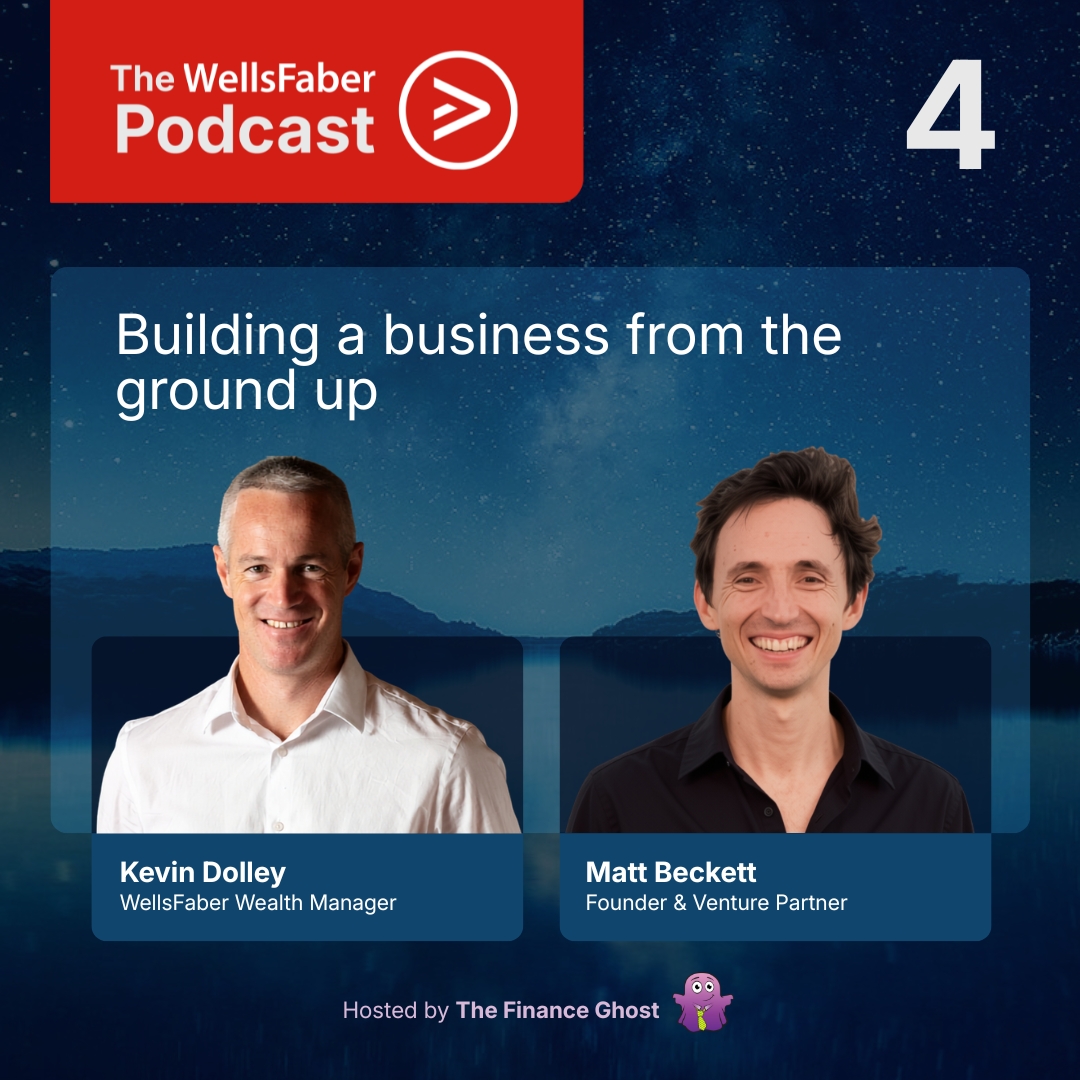
[00:00:00] Speaker A: The Wells Faber podcast is about helping you live the life you want. Wells Faber believes that money is about more than the figures in your bank or your investment account. It's about having the confidence to thrive as you achieve your life goals, supported by a sound financial plan. Hosted by me, the Finance Ghost, in partnership with Wells Faber, this podcast series features expert guests and insights from Wells Faber clients who have overcome challenges and unlocked key learnings in their wealth creation journey. Episode four features Kevin Dolly of Wells Faber and Matt Beckett of N1. If you're on the journey of building a business, this one is for you. Welcome to this episode of the Wells Faber Podcast. I'm your host, the Finance Ghost. I'm really looking forward to digging into this and the last few episodes we've been very focused on, firstly, the health side of the wealth and health equation, which has actually gotten me to make even more changes to my life, even though I'd made so many before doing these podcasts. It's amazing when you have a conversation with people, you kind of look at it and go, hmm, maybe there's still some room to go. We've had wonderful conversations with people about having to somewhat reinvent themselves and make some big changes in response to things happening in their lives. And today we're going to do something completely different now. We're going to put far more of a business lens on this. We're moving firmly into the wealth side of the health and wealth equation, which is obviously very important.
To do that today we have a familiar voice that is Kevin Dolly, wealth manager at Wells Faber. And we have a new voice on the podcast that is Matt Beckett. He is the founder of N&1.
Looking forward to chatting to both of you. Kevin, let me say hello to you first as our familiar face and familiar voice, and then we'll get Matt involved. So, Kevin, welcome.
[00:01:32] Speaker B: Thank you, Ghost. Good to be again.
[00:01:34] Speaker A: It's great to be doing this with you. And Matt, welcome to what I understand is your first ever podcast, right?
[00:01:39] Speaker C: Yes, it is. Thank you. Thanks, guys. Thanks, Kevin. Really great to be here. I love what you guys are doing so far.
[00:01:45] Speaker A: Fantastic. Look, you got to pop the podcast cherry at some point in the modern world, so I'm glad you've now done that. So welcome and let's start with you. Let's get an overview of N1 and some of the work that you do with founders, and then I'm keen to understand your involvement with the Wells Faber team and how you guys work together. So, Matt, take us away on what n +1 is excellent.
[00:02:07] Speaker C: Thank you. I'll try to give you the high level. What N1 is, is effectively a venture studio with a mission to build effective mechanisms to invest in everyday founders at day one.
So that's a fairly long statement, but really it's about starting business. And I think many people in the business world, or all the founders or would be founders, know that you don't really get investment unless it's from your uncle or your dad or your mom. At the very early stage of starting our business, we know there's a ton of talent in the country, we know there's a ton of opportunity, and we know that we're following a model that really isn't built for South Africa. So we are trying to figure out how we get this new money and support into everyday founders and everyday businesses at the beginning of their journey.
[00:02:53] Speaker A: Yes, you're really getting to the heart of the problem there. Right. Because you're 100% right. Lack of funding is a major concern for entrepreneurs in South Africa along with so many of the other problems that of course they have to deal with. And I'm quite keen to dig into that with you. So Kevin, just as part of setting the scene there, what is your work with Matt and why were you keen to, I guess, bring him into this discussion from a wells favor perspective?
[00:03:16] Speaker B: So Matt and I met about five years ago when he moved down from Joburg like a lot of people have done. And we met on a bicycle, we became mates and later on we started chatting about financial planning. And I obviously got very interested in Matt's business and what he does and how I can introduce clients that are going through that phase, you know, maybe resigning from their jobs and trying to start a business. How can I assist them along that journey? Clients naturally come to their financial advisor for that type of advice.
Not always, but, you know, if you have a long standing relationship, you're one of the trusted years that they're willing to share this information with and they ask for your advice on what steps they should follow. And partnering with someone like Matt really gives that level of expertise that clients trying to embark on this journey can actually tap into.
[00:04:01] Speaker A: Yeah, I love that. It's that trusted advisor concept. I actually remember reading the book Trusted Advisor all those years ago when I was in corporate finance. It's about helping your clients actually know where to find the answers. That's what it comes down to. So that makes a lot of sense to me. Sometimes those answers are easy, sometimes they're harder, but it's amazing how often the questions are consistent, even if the answers are not. So startups and certainly South African businesses face a lot of challenges. We know this financing is one of them, is all the operational stuff. If there's one thing this country loves, it's regulation that is probably way beyond the level of economic growth actually available. Tax stuff is not simple. The legal stuff is not simple. There are actually very few things in place to make things easier for founders and obviously these are, these are headaches, you know, in a market that's already difficult to operate in. So South African startup entrepreneurs are a rare breed. They are super resilient and it's something that I think we're known for internationally, actually. Matt, if we look at a lot of the work that you do and in terms of your expertise and where you spend your time, what are some of the things that tend to come up from these companies? What are they facing? What are the common questions and the common problems that you deal with?
[00:05:07] Speaker C: I think maybe I cut myself short with the model we're trying to apply. Let me give you a little bit more on the what we do and then jump into the problems. Just to answer the first part of the question. The questions that come up at a certain point are very repetitive, are the same themes. A lot of what we're dealing with is the problems that aren't yet. The questions that in early stage founders, they're not yet sure of which hurdles they're looking out for. And that will apply to everyone starting a business journey or starting a new career. You don't actually start out knowing which questions to ask.
Just a brief on what we're doing. So we addressed why and where we're trying to build. How do we start new businesses? For me, that's the problem very clear. It's a big problem, which is why playing in this or trying to address this, it's not charitable, it's impactful. Can we start new businesses and create economic wealth, create first generation wealth and new jobs? The how is what I wanted to add. So what we are looking at and what we've gained over the experience of working with across the board, some really grassroots founders and businesses up to businesses that are kind of exiting startup and going into scale is that we kind of come to the conclusion you must apply skills and capital together. If you really want to act at an early stage and provide the support for the right founders, you must have input. Now that skills can be a broad word. Be that business services, be that advice, be that partnership. I'm sure we'll get into some of that, but you must have the effort and the money coming from the same place with the same incentives because often those things don't come in at the same time. And that can just land up confusing the founder or giving them an amazing direction and pool of support in one grounds and nowhere to go on the other, obviously. The other side being we can also put a lot of money and then let it kind of float around and get surprised when the founder doesn't have his services in place and doesn't make great decisions, that gives a bit of where and how we're doing it. And then if I can come. Right, touching back to your question, you're saying, what are the biggest challenges we're facing in the early stage and without partners? Right.
So, yeah, from that, where we start, I kind of got three areas that we'll touch on in direct response there. The first is the accounts, but within that, the management reporting. Seeing your books, seeing and understanding your numbers properly. Yes, this translates into the compliance questions which will come up very commonly. Are you compliant? Are you on time? Are you falling into problems with sars? But before that, and I do say before because it must come in this order, do you actually know what's happening in your business? So when you're a tiny founder, when you're just starting out, and again, I'm not being, to me, this is not rude or derisive to any starting founder. This is the mission. You want to be able to work with guys who are great operators that haven't dealt with income statements and MP201s, let alone operational efficiencies and financial ratios. So when you're starting, you know the numbers because you're the one selling the burgers. You go, I'm not committed that we're using burgers as our example for today until someone changes me on that. So, you know, you bought this many buns and this much mints and you sold this many burgers and you understand it, but you're not really sure what you should be looking at, how you should be structuring your cost of sales, how you should be accounting for your own time in the business. And then as soon as you start growing, you lose a track of this. All of a sudden you're integrating one point of sale here and one supplier there. And if you don't come from this world, you will lose track. You will not know exactly what your numbers are and what you're looking at and where things are going.
To me, building this into, you know, really getting that in a way that speaks to founders and helps them to understand their business is number one. Without that, you're not growing correctly. And with it, you really can make good decisions. So the second is that we can take that kind of management, reporting, accounting, strategic management, and we can take it through to, I believe, all non operational elements of the business. And I say non operational, where you've spoken about some of the operational challenges. Those operational challenges are different in creating burgers to what they are in creating school uniforms or farming, but accounting, legal, branding, communications, digital assistance, and humans or hr, they have the same levers, they look the same. You know, every business can talk about production, distribution, sales and compliance broadly the same. And I believe that we take the same challenges into all of these business services with which founders will surround themselves as they go. And most of these things, when you start out small, you go and hire an outsourced accountant, you hire an outsourced brand agency. It takes a lot of overhead. A lot of the time, those guys don't really get to understand your business, the good ones do. But the overhead, the time, the administration, and the mental burden that you as the founder are taking on dealing with this, updating forms, explaining, creating briefs is this unspoken load that sits on founders backs. You emailing with your brand guy here, you meeting with your accountant there, you whatsapping with your lawyer here. And actually you're spending as much time giving them info as they are giving you info. And you wonder why you only spend one hour this week figuring out there you go back to burgers if you should grind your beef really fine or smash it up while you're grilling it. So then all of a sudden, a year later and our burgers aren't amazing anymore. Is that a surprise? So that to me has been the biggest challenge. I maybe go a bit too deep on it because of how much it touches me personally that as we've built up this studio, we've worked really hard with a few different partners, some cataclysmic failures, some really great relationships that we're building in. How do we get to understand and streamline the services for these businesses in raising this here where hopefully we have some potential new founders, young entrepreneurs, listening. Point is not necessarily to sell that we're nailing it, but to raise the big learning curves can be quite tiresome and no one gets them right straight away. And also to understand you don't need everything all at once in the business.
Last piece, which is a very short one, is the things that actually are the soft elements, the human parts, there's the phrase somewhere you don't do business with businesses, you do business with people. And that's no matter what you want to build something. Well, number one, actually the number one priority, while it might not be the first thing, is your team and the systems. Are you hiring good people, are you training good people? And then are you building ways that you do things? Systems, to me doesn't mean we have to employ a million different software as a service subscriptions and build a fancy IT infrastructure. It is, do we have fixed ways, fixed operating procedures? When I'm day one in my business, do I create documents that remind me how I do my job day to day so that as I build people into these roles, we can expand properly?
[00:11:50] Speaker A: Yeah. So loads of good stuff in there, Matt, which obviously speaks directly to life as a founder. I can confirm myself five years deep in this thing now. And one is definitely the concept around understanding numbers. And you're absolutely right. Unless you come from some kind of accounting background, it's extremely hard for a business owner to actually understand the numbers properly. They have a sense of the cash, but they don't necessarily know how to read the financials. Their accountants will often do the bare minimum to just comply. Generally speaking, you struggle to find better than that. And compliance, yes, that's obviously the ticket to the game. But if you actually understand your numbers, and I've worked with small businesses before, it's amazing how you can just open their eyes to something by showing them stuff like margin, mix and all sorts of concepts that if you studied finance, are not complicated and once you've seen them, are not complicated, but you just don't know what you don't know. And that's where it helps to actually get someone involved. And then speaking directly to stuff like the overheads. Yeah, I mean, you certainly. Speaking my language there. It is incredible how much time. It's sucks in a business to just do the stuff. It's like adulting in your normal life, you know, just all that stuff you have to remember to do for your household and your life and your kids, et cetera. If you have a business, it's all of that, but the kid is the business and it's a demanding kid in that particular case. So there's a lot to think about there. I can completely relate to all of that. Honestly, it's not easy to be an entrepreneur because you pretty much have to do all of those things yourself and only over time do you start to then outsource it. So it does make sense to get the right people involved and I think specifically to try and find the right people for a small portion of their time rather than getting the wrong people in as full time employees who then want to take leave and get sick and everything else. That's certainly been. My approach is to manage those overheads. I mean, you spoke directly to overheads there. Overheads are where things go wrong for you as a small business owner. And whatever you can do to optimize getting the right people in and, and managing your overheads is a good idea. Pleased to say I finally brought on someone full time in the business who's been amazing and it's an absolute game changer when it happens. But yeah, five years in, it's taken that long to get to the point where it actually makes sense to do that. Anyway, let's move on from that to Kevin, because you must have been sitting there listening to all of that and waiting to jump in and just share your experiences, I guess, in terms of your own clients. So I'll open the floor to you, Kevin. Talk to us about, you know, what jumped out for you there. Where does that really resonate in terms of your, your clients and what sort of conversations does it lead to?
[00:14:12] Speaker B: I think the things that Matt chatted about there, I mean, to summarize it in my simple terms, you as a founder that wants to start a business, you have a passion about something or you have expertise in some field and that's what you want to do, right? That's what gets you excited to actually start this business. In my mind, you should be focusing the bulk of your time on that. And yes, most of the time you don't have the financial background, you don't understand all of those accounting and compliance things. But that is the whole beauty of partnering with someone like Matt, because he's done that a million times, he understands that world. So you don't have to focus your time on it. You can focus your time on making the best burgers in the world because that's what you're passionate about and that's
[00:14:53] Speaker C: what you want to do.
[00:14:54] Speaker B: Having someone in your business like Matt, that can help you navigate that and identify the areas without you having to worry about it, you know, and to step in and say, look, I think we need to outsource this, or hold on, I can manage that for you. That's the beauty of it. Whereas if you go into this thing by yourself, all your time and energy goes into the running of the business and sometimes you lose sight of, you know, why you're actually doing it. And what actually drew you to it in the beginning, obviously where the financial advisor comes in, and that's my role, is to. Depending on where you entered the journey with the client, with the founder, it's important to lay a strong foundation from a financial planning background to ensure that if and when things do go wrong, that you've taken into account these things, that you have preempted it. And there's a lot of things that your financial advisor needs to understand when you're starting a business to try and guide you to try and lay that foundation. And a lot of those questions would be around, you know, are you starting this on your own? Do you have a partner? What do the shareholder agreements look like if you do partner with someone? Succession planning, often we feel like that only happens later on along the journey when you're getting closer to retirement or exiting and that sort of thing. But anything can happen at any point in time. And you've spent so much time and effort building this business which has a value. Like Matt said, it's first generational wealth that you're trying to build. You want to pass that down to your family.
So a financial advisor will help you put those mechanisms in place to make sure that if something does happen to you, that there is value passed down and to start having those conversations early enough to start thinking about succession. There's other factors to consider. You know, if you don't have a will, for example, what happens to your shareholding when you pass? How are you married? If you are married, you know, are you married in community of property A and C? How do these affect what happens to the shares business when you're no longer around? Founders don't think about these things. And yeah, technically they shouldn't have to worry about those things. They're focusing on growing a business. But having the advisor just remind them about these things allows for a proper foundation to be put into place and to have those conversations. The other advantage, in my opinion, is that advisors generally have. If you've been around for long enough, you'll have a big pool of clients who have been through maybe building their own businesses in similar industries, people that you can connect to this founder, even if it's just a coffee, you know, to have a chat and to share ideas. I mean, there's so many people out there that are willing to part with that knowledge and help other businesses grow. But you've got to reach out, you know, so through a network that a financial advisor can give you, you can enable that. Matt is trying to solve for this in various ways, and he's experimented quite a bit with it. And this is part of how we started our journey as well, to try and build up a network of professionals in accounting, legal, financial planning to be able to assist the founders. Right. So he's been doing a lot of work on that, and we've partnered in that sense, and I've helped some of his founders to get things in place. But the financial advisor themselves, just by the nature of our business, we've partnered with accountants, tax consultants, and so on, because we need to do that for our clients anyway. Fiduciary specialists, you know, when there's trusts and things, we have a network as well that we can tap into, and all of that can support the founder in all of these functions.
[00:17:59] Speaker A: Kevin, lots of great stuff coming through. Then. I think it makes a world of sense to combine business value creation with wealth management at the end of the day, because the work Matt is doing with these clients is helping them create the legacy wealth that you need to plan for down the line. So that makes a lot of sense. And I think it also just helps to get that external perspective and that kind of helicopter view on your business. And someone's actually coming and say, this is, you know, this is interesting. This is what you do. Have you thought about this? So I can introduce you to that person. It's like the architect designing the house that you'll then spend your time furnishing. The other thing that I think you mentioned there, which is a concept that is very close to my heart, and people who don't run businesses don't always understand this because they earn salaries and hence their earnings are capped. So they'll often form a habit where it's like, okay, if I do this myself, I save money and I don't have another way to monetize my time. I'm just giving up some free time, but I don't have an alternative use for it that generates money. So hence I'm going to choose to save money. But when you work for yourself, and inevitably. Well, not inevitably, but if things go well and you have more demand for your time than supply, then you've got to be very careful. You've got to get good at paying other people to do things you don't want to do, it's all good and well to spend an hour saving a hundred bucks. But if that hour cost you two grand, then you've actually gone backwards while patting yourself on the back for being very clever for saving a hundred grand. So that's a big Adjustment for entrepreneurs, and it applies to everything in their business. There's some stuff you should be doing, your core thing, actually making sure the burger menu is perfect. And there's a lot of stuff you definitely shouldn't be doing. And it took a lot of trial and error and pain for me to get out of that mindset, especially in the first couple of years as a business owner, to go from salary to business owner and to learn that, actually you've got to then be strict with your time. And just working yourself to death is not smart unless you're working on exactly the right stuff. All you're doing is burning yourself out and. And making it much harder for you to be really good at the thing you need to be good at, which is the burgers, Matt, to maybe bring it back to you, then. And I know you've got some background in coaching, actually, which is quite interesting. Cause I naturally did a little LinkedIn stalk, and so I'm keen to tap into some of that. But mentoring and coaching, that's part of what you would offer, I would imagine, to these founders. People hear the word coaching and sometimes they go, ooh, what does that mean? And it's weird because they do that in a business sense. But if you say to them, russie and the Springboks, then there's no negative connotation with coaching whatsoever. It's like, the man's a genius. Look at what he's achieved. But you say to people, business coaching, and they go, oh, what's that thing? So it's quite strange. I mean, we should actually treat it the same. We should treat your business as a professional sport where it actually may make a huge difference to you to get the right coach. And you shouldn't be shy to experiment with that. Change your coach if it's not working, like any sports star would do. Let's talk about that a little bit around some of the coaching and mentoring stuff that I'm sure you get involved in and how you walk the road with these founders to just give them that support.
[00:20:42] Speaker C: Thanks. Glad you checked out some of the history. And that's super relevant. It's nice to race something. I personally forget a bit the history. My career started out in cycling performance coaching when I was a youngster. That was the dream. We were going to go race Tour de France, all of that. Grew up with some of the guys who really exceeded. And it put a different lens on everything for me.
[00:21:02] Speaker A: So when Kevin said he met you on a bike, what Kevin meant was he met you at a coffee stop on a cycling route because previously you had like missioned past him at a million k's an hour on his favorite route. This is what I'm hearing.
[00:21:15] Speaker C: Actually back then Kevin was pretty quick as well. Now we both in a state of semi retirement from cycling because we're both slightly hypocrites to, to the point that we both nodded our head out of you talking, you know, don't burn yourself out, don't overwork and currently see Kevin cycled one hour last week and that's about 45 minutes more than I did. That's you know, so I'm maintaining health. That much fitness at the moment is an important minimum threshold.
[00:21:42] Speaker A: Yeah, LinkedIn stalking is one thing, but Strava stalk something completely different.
[00:21:45] Speaker C: Eh, Driver gives you truth man. If we're not getting out and healthy, we in trouble. And so my life started out in performance coaching. I then went on a whole long entrepreneurial journey which had been great. That's what got me here. I started as an entrepreneur, not as the technically trained account or whatever that may be, which is the opposite way to a lot of guys who got to the same place. And we'll always frame those questions, those concerns the perspective of the empathy for a founder. Differently then through my career I added some of what I saw as the technical elements of business. Looking at this idea that these founders could be supported differently and like you said, be not doing the things to kind of paraphrase yours. You don't have to go and learn cash management plus brand management plus legal. You have to understand the direction you're taking. You have to understand that people you get in place are doing the right things and then be able to guide some of the big decisions or directions. So this loops to the coaching, you know, that's always been an interest and I believed when I started out this idea of venture building and venture partnership that a lot of it was going to be about the technical elements. Is your financial model good? That to me I think we will probably all know that's that's easier. Spreadsheets do what you tell them to. I can make you a model for the next hundred years if we want to. It's definitely going to be inaccurate once you get past a few years that can do that. But really the thing about business, the thing about developing in life and I really love, I love a good sports analogy, is day to day improvement, day to day consistency, accountability and having someone that's really where a lot of the coach, the Russies coach is not just about the technical. It's about the human. And I've spent so much of the last two years actually in that space. Do we provide a sounding board? Coach doesn't need to be better than you at the game. He's not necessarily better or he's definitely not better than Malcolm Marx at tackling. But we can frame, we can see from external and we can provide a sounding board. Then you have a bit of accountability because as soon as you're sharing it with someone else, you inherently stick to some of the decisions and then there's just an element of sharing some of the mental loads. So the key takeaway don't do sports without a coach. Don't do business without a coach or a partner, whatever the exact terms you put on that. And I also really believe it is valuable to even go into the terms and say coaching is essentially a one way relationship. It's not an equal relationship. Even where you have a co founder or a spouse who's amazing. Having someone who's dedicated when you have a session to talk about your business, your problems is not a coffee where we also hearing about my problems. And that can be a real magic in coaching. I now add one piece to that that I've to my own detriment or my own learnings. That's what this business is life. And business is just about putting together a lot of learnings and actually listening to them. And I was under indexing on coaching. I was doing a lot of coaching and not receiving a lot for a lot of my career once I got to a certain level of being able to apply some coaching. And when I went through my cycling career I'd studied sports science man. So I did my own programs and I wonder why I burnt out and starting in business as well. I had peers chats and I never engaged strongly enough with the very, very many willing humans out there who are willing to coach or or mentor or guide. I know everyone. There's not a single person listening to this podcast who doesn't have someone who will coach mentor guides. If you say hey Uncle Pete, can we actually have once a month a coffee where I talk to you about my challenges with my team or my challenges with the finances my business. And it goes a very long way. So I now have those things in place which I didn't before.
[00:25:22] Speaker A: Yeah, very nice. I'm kind of deciding what the next area looks like for me because it's been five years to get this business to this point point and that's been done through blood, sweat and tears on a lot of technical Stuff now that I can start to outsource just some of it, I've kind of figured out which pieces of it I can start to outsource. In theory, that should unlock more time. The first thing I'm going to do with that time is try not to work 70 to 80 hours a week every week of my life, because that would be kind of exciting. But once I've brought that back down to Earth, probably around 60 hours, then I'll try and find a few hours a week for just bringing in some more human elements. Because I think that's what's been missing from a lot of what I've been doing, which might be coaching, it might be something similar, which is interesting. So we'll see what happens there. Definitely not sure what the future holds on that for me, but it's good to hear you having such a great time doing that kind of work with people. And it's such an important role to play. And I guess it comes through even when you're talking about something like understanding their accounting. It might be a chat about the accounting, but actually there's a coaching element to it, without a doubt, which is around imparting knowledge, creating the goals. Those elements do come through and I think it's interesting that your background is not in any one particular technical vertical. And I think that probably makes you way better at what you're currently doing.
Because when you come at something with technical expertise, then inevitably that's your lens, right? So you come at it as a chartered accountant who understands the financial numbers. That's your life. So you're going to look at it like that, you're going to be really good at the financial stuff. But you might not necessarily be amazing at helping someone understand who to speak to about marketing or digital or outsourcing or whatever the case might be. So it's quite good to come in with that overarching understanding and then you know where there's a gap and you need to plug a technical expert into it.
Speaking of technical experts, Kevin, there's a good technical point here that we should talk about which is around structuring some of the stuff like health insurance, retirement savings, all of that kind of thing. I mean, again, don't try and become an expert. Like I'm scared of that stuff because it is actually so technical, it's so specialized. Like there's no reason for the burger making entrepreneur to go and try and become an expert in which health insurance plan to use. It's just a horrible use of your time. Go and get an expert who knows how to do it, and we'll just charge you a fair price for getting involved in that. So, Kevin, let's maybe talk about that a little bit. For business owners, especially as they start to hire people and they need to incentivize them properly, what do they need to think about around, as I say, stuff like medical aid, retirement savings, and those sort of perks.
[00:27:37] Speaker B: Before I answer the question directly, I think it's important that we, you know, when we start talking about hiring people and hiring the correct people, having your values as a founder align with your business and also the people that you hire is very important. I think it creates a really good synergy. People that can share in your ambition, that want the business to grow as you do and have the same sort of grit and determination that you have. Because starting a business like this, you need that. And speaking to that, you're hiring really good people that you're going to form a relationship with over time. They're not just going to be employees, they're going to be a little bit closer to you. You know, some of the businesses Matt's been involved with, there's a bigger social element as well. You're trying to improve the lives of people. You're trying to solve an issue in South Africa of, you know, where we have quite a high unemployment rate. You're trying to employ people, but also just in general make people's lives better. And some of the services that I can provide would assist you in doing that. One of them is health insurance. We know that our public health system's under a lot of strain. Having some access to private health care in an affordable way is a really important solution that the industry has tried to solve, and I think they're doing a really good job at it. So there's quite a few health insurance products out there. It's not medical aid specifically, because those are very expensive and just sort of unachievable from a cost point of view. But there's health insurances that are fairly affordable, give basic private health care, and that's a real value add as a founder, giving some benefit to your staff. It can also help with staff retention. Obviously, it can help with absenteeism. Just as an example, some of these health insurance benefits deliver chronic medication to your place of work.
So often people have to take a whole day's leave just to go stand in a state clinic queue to get their chronic meds once a month. And that's unproductive for the business. So having a solution like this in place can really add value. But I think what's important is that for each founder that's going to have a different demographic with regards to their staff, it's important to engage with them. And that's something I would always encourage, is to engage with the staff, find out what's important to them. We might think that retirement savings is vital. You know, let's try and solve for that issue. But for them it may be a distant thing that's not really a priority right now. They need a better life today and not just in 20 years time. Maybe retirement savings is a secondary, maybe health insurance is more important or maybe having funeral cover in place is a priority.
Having some sort of short term savings that they can access within five years. So some sort of a savings mechanism where, you know, five years service in the business and you get a nice bonus paid out and you can build a house or you can do something meaningful with it, I think that adds real value. But to have these conversations with your staff is what's important to understand what's priority for them. So there's a lot of employee benefits that I can bring to the table to speak to that. And then also with regards to the founders and the shareholders and how they partner, there's certain risk protection covers that might be necessary. Let's say, for example, the founder stands surety for a loan in his personal capacity with a bank or with any other funder. There may be a condition where a life policy is required to cover that debt. So those are the type of solutions we can put into place as financial advisors partnering with founders.
[00:30:49] Speaker A: Yeah, Kevin, I think the overarching take out there is just meet people where they are, just listen to your staff and understand what actually matters to them and then take that into account in what you're structuring. I think that's extremely sensible advice. And, and then obviously get into the technicalities and get the right person in place. I can't stress that enough. I think, Matt, to bring it back to you and just listening to Kevin's answer there, other than the nuts and bolts around structuring, anything you want to add to that in terms of a successful strategy to attract and actually retain employees? I mean, you see this all the time with the founders that you work with. What would you say tends to work really well.
[00:31:21] Speaker C: Thanks. And really echoing a lot. I mean, that's where Kevin and I have worked on one or two instances and we're trying to roll out some more in the same direction. Well, I'll start with culture. Start with culture. And then give most of the emphasis to the finances and exactly what you've spoken to. But all of these businesses, it feels like lofty Instagram motivational posts or textbook advice for founders. That seems like it's less relevant. But really, is there good culture in the business? This is not just about the mission. And the values of the business is do people like rocking up to work every day, Are they rewarded when they do well? And do they have space to learn when there's errors so that they're enabled to try things, to learn things, to own new pieces of the business? Or is there shouting, is there disciplinary for little things, for unnecessary things? There's no rocket science in that. You know when you're creating a room for someone to grow and you know when you're not. And I think that's just bigger than anything else. The difference that's especially in retention.
One of the challenges is that doesn't necessarily play a part in attracting on either way. If you're the employee, you don't know if the culture is good when you're coming in. And if you're the founder, it's hard to communicate great culture when you are attracting. But as you go and as you build those things, they really do become impactful. And then the next is the same idea, this thing, how do you make it good for the people? Where do you change a bit of their lives? And especially when we are talking about so large tracts of the country that really are fighting to make ends meet, where is the little difference where some medical, some savings changes their prospects, their feeling of trust and engagement from the business and actually their lives. As Jeff mentioned, now you're not spending one month every day at the clinic. So we've done that really well in one or two occasions. And we have seen that these small bits change how people feel when they've got some medical insurance, when they see that they're employers really just are paying attention. And where those two connect to me is growth opportunities and building long term relationships with your team. One day maybe I can say we've got a fixed recipe for this, but you still will continually have surprises on both ends. You'll have guys who blow the lights out and people who let you down that you thought they could do something and they can't or they don't fit. It's always a question, do you invest and continue to train or is this not the right fit, but continuously. The guys who've really shot the lights out for me are those who've started relatively low. It's the nature of some of the businesses we're in, that there is that opportunity two in mind here. One person started as kind of a back of house runner in one of the kitchens that we're involved in. And one of the guys started as a junior foreman on a building project and then grew in a, in a farm business that we're involved in and has taken it every step. He's been given the opportunity to grow, given some of the investment around, actually just moving savings, moving, moving the medical. When those two connect, you really get a culture that guys can see they have a space at the business and they care and keep showing up for it.
[00:34:24] Speaker A: Some great stuff to think about there. I love it. So, Kevin, let's bring it back to you as we start to close off on this podcast. We know South Africa is not an easy place to start or run a business for that matter. And if you could leave the listeners with just one piece of advice around financial planning in the context of smaller businesses. I don't want to say small businesses because even as they start, start to get bigger, there's a lot to think about, particularly when they get more staff, you know, then it actually becomes even more important around the financial planning. So if there was just one thing you'd like listeners to take out from this, what would that be?
[00:34:54] Speaker B: So I think have a discussion with your financial advisor right at the beginning when this idea pops into your head that you want to start a business, have that conversation immediately before you do anything. Let's say you starting a business that you haven't even resigned from your employer yet. Let's say that was your path. You're resigning from your corporate job and you're starting business.
Have that conversation right away before you even resign, because there's things to consider along the way. So you might have a pension fund. A lot of people will just pull that money out, pay a ton of tax and then pump that money into their business. That's not always the right decision. So the point is, have a conversation with your financial advisor as early as possible in the journey and be as financially frugal and disciplined as you possibly can be. And sometimes that needs a bit of guidance and a bit of plan if you're going to start this journey, especially in South Africa, there's risks everywhere and we've had some spectacular stories of failures and learnings, which is great. But to make the journey easier and your chances of success being higher, try and be as low on expenses and debt as you possibly can be. Cut back if need be. Matt and I were talking about this earlier. If you driving a fancy car because you've been sitting in a corporate job, scale down, sell that car, buy a cheaper car, cut your expenses, take a bit of financial pressure off of yourself so that when you embark on this journey and you have a few lean months, you're not going to feel it as much. And make sure that you have a nest egg. We like to refer to it as an emergency fund. But have cash, okay? Have liquid cash available so that in this journey you're going to have a year or two where your income is nowhere near what it used to be. Have that safety net, have that cushion because it takes a bit of, a lot of the financial pressure off of you and you can focus on your business instead of being completely stressed out because you're not making ends meet. So that's kind of my message is try and be as financially sound in this journey as you possibly can be because it'll take a lot of stress out of it. It's unnecessary stress that you don't really need on this journey if at all possible. Obviously everyone's got different situations and backgrounds and levels of expenses, but yeah, if that's a takeout message, that's what I'd like to impart.
[00:37:01] Speaker A: Yeah, I like it. I must say I can echo that view. Like the good times will come if you do the right stuff. Don't rush them and then create pressure for yourself and potentially throw away everything just because you don't have patience. Kevin's just much nicer than me and he puts it so nicely. Whereas I've kind of been in these trenches and seen how people make these mistakes and always pull your hair out. What are you doing? You don't need this overhead right now in your life. But anyway, Matt, let's end off with you. Fair amounts of positivity in the local economy. Interest rates have come down at 50. Feels like things are actually getting better. It feels like it's the best it's been in memory for me, really. I finished varsity in 2010, so I've only ever known difficult markets and post global financial crisis and lost decade in South Africa and Covid and all these other excellent hurdles along the way. Starting to feel at the moment like things are getting better. Is that being echoed by your views and your clients views. And final question for the show is just how are you feeling? Give us a temperature check on your sentiment but also the businesses you work with.
[00:37:56] Speaker C: Awesome, man. Thank you. Yeah, the quick answer to that is you're feeling good. I think we are all probably of similar ages and reality. We've lived most of our professional careers sitting. I'm 40 years old now and I live most of my adult life in some form of whether we call it recession or hard times, we haven't had this growth path and clear skies ahead of us now, whether it's fully clear skies, whether there's political changes or not, we are I believe firmly we're moving in some really nice directions. So yeah, I feel like we're going the right way. I feel like there'll be some more great capacity for investment into new ventures, into new opportunities. Which means those looking to start those will have places they can look and is doing them. There's the consumer economy is growing, there's more people earning better. There's people supporting these small businesses. And now I want to jump with a very quick shout out to three of the businesses because they speak to very specific different opportunities.
I have an amazing founder in Kabokweni, the township outside of Nauspress called Spiwe who is selling school uniforms. This is absolute growth that could not have happened even two or three years ago. We've been with him for a little over a year and in this year he's onboarded 13 new schools of about a thousand kids each who are now formalizing their school uniforms. And two, three years ago these township and model C schools and government schools, that just wasn't even a thing. You rock up how you rock up. It's such a great thing that this market is growing and I think that goes right across a lot of informal becoming formal markets. And I have a catering business here in Cape Town that is just seeing, that's just consumer, nothing fancy. It's just more people spending some good money going out to meetings, being in offices and we spending money on lunches. And I see this, we're in the waterfront, it is full every day. There's tourists, there's locals, there's businesses growing. And the last, we've got a business in Dalstrom. Just the last of the shouts now is all we need. Working in some amazing new farming, just straightforward farming, supporting first generation founders and the accessibility of tech. So that's why I wanted these three different ones. They each have three different things. They're looking at the accessibility of tech and what it is enabling again that's even a year ago wasn't there that we now have easy management systems for, for farms tracking their produce, for teams running their tasks. And between those three things, some new markets, consumer economy growing because there's actual good sentiment and available tech if I'm sure with many more ingredients. I think we in a very good climate to do some cool stuff.
[00:40:30] Speaker A: Yeah, it certainly sounds like there's a lot to get excited about as we head into a new year, so we're going to leave it there. Matt, Kevin, thank you so much for your time. For listeners who want to find you. So Matt, it's N1, NP1, CO ZA, and of course that's Matt Beckett on LinkedIn. You will find him there. I know this because I LinkedIn stalked him myself.
And Kevin, that's an easy one. Wellsfaber.com check him out. And of course the team from Wells Favor. You are listening to the Wells Favor podcast, so chances are very good you know where the Wells Favor website is. To the listeners, Good luck those of you who do own your own businesses and for those who are maybe thinking of starting one, double luck. It's a very exciting thing to do. Mildly terrifying, but can be hugely rewarding. And I think the overarching lesson today is don't be SC to get some help. So, Kevin, Matt, thank you so much for your time. It really has been a great discussion.
[00:41:17] Speaker C: Thank you very much, guys. Awesome stuff. Great to have the opportunity to chat and well done. Brilliant.
[00:41:23] Speaker B: Thanks so much, Gus. Thanks for hosting us. It's been a great chat and take care.
[00:41:30] Speaker A: Please remember that this podcast is for informational purposes only. For bespoke personal financial advice, speak to a Wells Faber wealth manager and visit the Wells Faber website for more information.
Wells Faber is an authorized FSP number 639. The views shared on this podcast are those of the individual concerned and do not necessarily represent the views of me, the finance ghost, or of well's favorite.