Episode Transcript
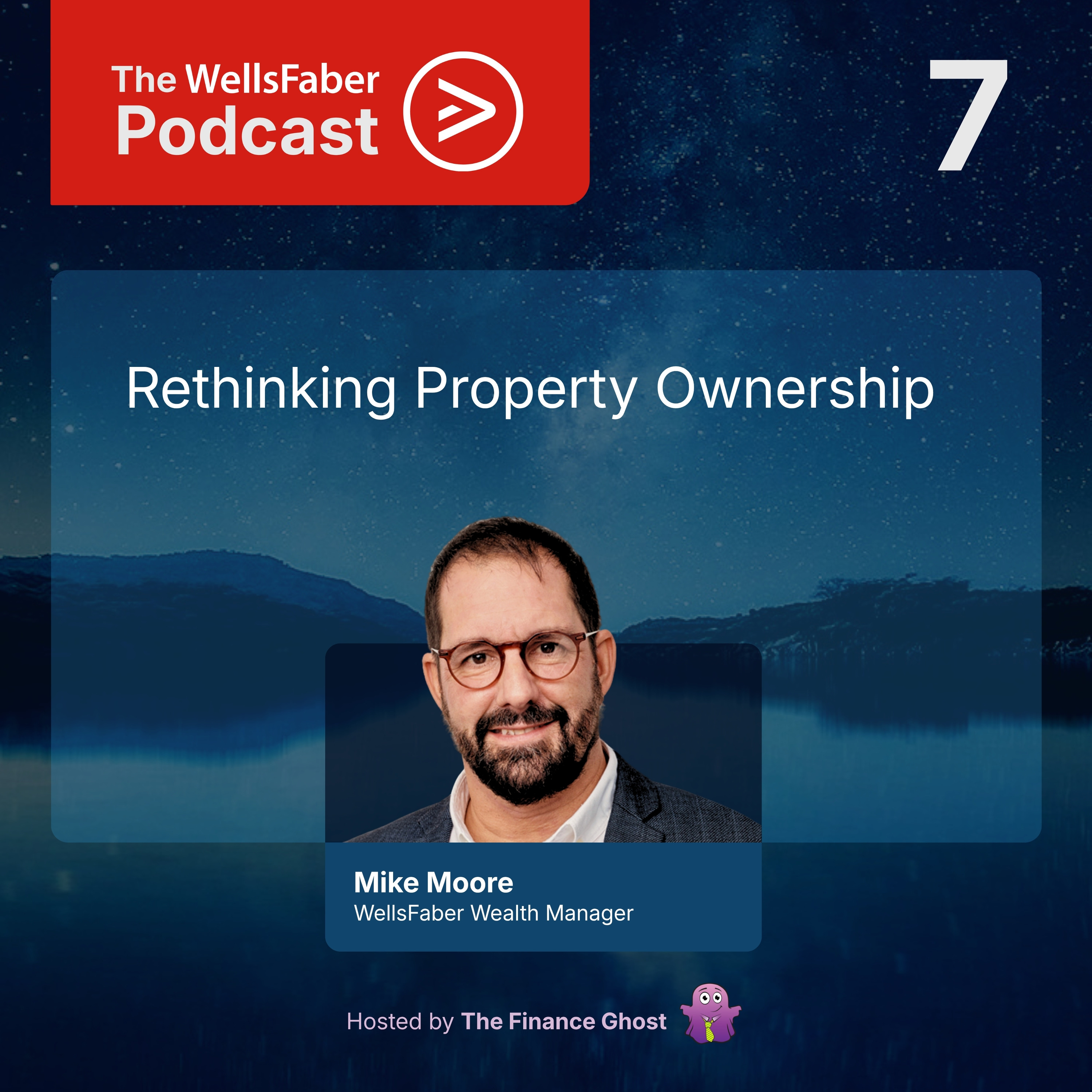
The Finance Ghost: Welcome to this episode of The WellsFaber Podcast. I'm here with Mike Moore of WellsFaber. We're talking about a topic that I think we're both actually quite passionate about, Mike, and that is property.
And that's because, in your world, you see it with your clients obviously - it's almost always their biggest individual asset. It's probably either their biggest pride and joy or their biggest headache.
I have these conversations with friends all the time. I've had my own good and bad experiences of owning property – I now rent, deliberately. Lots to talk about here, lots to unpack, and I'm excited to do it.
But from your perspective, why are we doing property today? What has triggered the thought?
Mike Moore: Hi Ghost, thanks so much for having me on again. Yes, property is a particularly passionate interest of mine, really just from an advice perspective. I've owned property – well, I own my own home. I've owned a property in the UK. When I left the UK, we still owned it for a bit.
But most importantly, the discussion with clients is ongoing. And there is this sense amongst people that property is some sort of extraordinary asset. It's some sort of extraordinary investment. It's superior to buying a unit trust or buying a share portfolio.
That's the sense that I get, and I always wonder why people feel like that?
I think it's a part of our upbringing. It's a part of our culture. It's a status-related investment. It's not unlike a car in many respects – except a car is obviously a depreciating asset and, arguably, property does appreciate.
I know you're passionate about it, so we've decided not to ask an “expert” or a client to come and discuss it this time. I'd love to hear your views.
Just get it under the spotlight and maybe bring home the actual truth around it, rather than the emotional sense that people have about it.
The Finance Ghost: It is a very emotional asset, as you say. We’re going to talk a little bit about international property, as you've referenced there.
I know the one example that you brought up with me is around people buying student flats when their kids are going to university – which seems like a great idea when your kid is your tenant, but I'm not sure how many people think about the next kid as their tenant, and someone else's student as their tenant.
But yeah, there's a lot to consider around property. This, I think, is very much where emotion and lifestyle meet finance. And you've got to just understand what you're doing.
As you've disclosed there, you own your home. I don't currently own my home, and I'll talk a little bit about that shortly, but let's dig into some of the maths, if that's okay?
Mike Moore: Let's do it.
The Finance Ghost: I’ve built a model that I use for my own purposes and I’m happy to share the overall thinking that goes into it. A lot of this stuff is really just maths and a set of assumptions, like all great models.
Some of the assumptions are grounded in fact, like the transfer duty on a house – that’s not a debate, it’s a regulated thing. Or for example how a bond amortises over time – once again, that’s maths. Some of them are a matter of opinion, like what the rate of growth on a house could be.
When building these models (and just a general point in finance), it’s really useful to use a lens of “what needs to be true in order for xyz to be the case” i.e. at what rate do house prices need to be climbing over the long-term before I’m losing out as a renter rather than a buyer?
This is where it gets really interesting, as different house price levels experience different rates of growth at different points in time.
There are also progressive taxes and costs, where more expensive homes tend to be penalised. So that can (and usually does) impact the answer.
But the overall principle is that my model sets the house price at a specific level and works out the bond repayment as though you’re buying the house. The theory is then to say okay, what would that same house cost me to rent?
In other words, we’re not saying you have R50,000 to rent or buy either way. We’re saying “what can you afford to buy, and that what happens if you rent that same house and do something different each month with the money you save?”
This is because the rent you pay for a particular home will almost always be cheaper than the bond repayments if you bought your home. This leaves a residual monthly cash flow that can be invested at an assumed return.
Again – an assumed return, not a guaranteed return, or a recommended return. This is a matter of opinion that just gets plugged into a model. Each person would need to consider their own circumstances here along with their financial advisor.
I’m not sharing any advice here, but rather just a view on how I model the rent vs. buy decision.
So, for a R4 million house financed over 20 years at 10.5%, the repayment is nearly R40,000 per month. There are other costs of ownership, ranging from rates to building insurance and maintenance. I’ve assumed an extra R5,000 per month for illustrative purposes, taking us to R45,000 per month.
That same house rented at an 8.5% yield is a monthly rental of R28,000. This creates a year 1 cash flow saving of R17,000 per month in favour of the renter.
There’s another initial cash flow saving in the form of not paying transfer duty and bond registration costs. Using an online calculator to estimate the costs, I found that they would be close to R360,000 on a R4 million house. This is capital that you need to have up front to buy a house, which means it had to come from somewhere else – probably an investment that would no longer be earning a return.
For illustrative purposes, my model assumes 5% escalation per year in the property. We have no idea what it might be, but we have to pick something.
That takes the value to R5.1 million after 5 years and R6.5 million after 10 years.
Assuming the minimum bond repayment is maintained over those periods, you would owe the bank R3.6 million after 5 years and just under R3 million after 10 years. It’s quite depressing how slowly it comes down, as so much of the repayment goes towards interest in the early period!
Assuming this is how the numbers pan out, it looks like equity value is created in the property over time – at least based on this maths. The property is worth more than you owe on the bond. But it’s a very theoretical number, as properties typically take a while to sell and attract fees like estate agent commissions.
The key assumption in the model is that we need to compare the realistic net realisable value of the property after a certain period with what an investment might have grown to for the person who rents instead of buys and saves that differential.
And by the way if we assume interest rates stay steady on the bond, then the saving differential gets smaller over time as the cost of the lease escalates each year. These are difficult things to try and forecast with accuracy, so it’s more about the principle and understanding the economic profile of renting vs. buying.
If you do the maths, the net realisable value after 5 years is R1.2 million. After 10 years, it’s R3.2 million. This is with basic assumptions around estate agency commissions.
On paper, this sounds really good. It’s more than R1 million in net realisable value. However, we need to compare it to the alternatives.
If we assume that the renter took all the savings from renting vs. buying as per our assumptions, including the monthly cash flow and the initial amount for transfer duty etc, and invested at an after-tax return of a hypothetical 5%, then it gets interesting.
Again, you can use any number there to see how the maths works. I’ve just gone with a hypothetical 5%.
After 5 years, the renter has R1.4 million (vs. R1.2 million for the buyer). After 10 years it switches around, at R2.3 million for the renter vs. R3.2 million for the buyer.
Under this set of assumptions, the renter is better off after 5 years and worse off after 10 years.
The reason for this is found in the maths. Over a longer period, the geared return from buying a house that actually appreciates in value at 5% a year (as per our assumptions here) becomes more effective, especially as things like the initial transfer duty have less of an impact over a longer holding period.
All else held equal, the maths is telling us that holding a property for a longer period of time can generate a better outcome. It makes sense as there are so many friction costs on the way in and out of a property.
One of the problems, in my opinion, is few people really hold their properties for long enough to experience that outcome. Life changes. People move cities or careers. And of course, there’s no guarantee at all that property values will go up, or by how much.
Investment returns are also variable for the renter of course, but there’s one big difference: the opportunity is there to spread the risk and diversify. Whereas when you’ve bought a property, it’s a concentrated risk you are taking.
Let me give you a very real South African example: if the area around the home deteriorates rapidly, that concentration risk will suddenly feel very, very real.
Mike Moore: Superb analysis. Just another point – you did raise it, but I don't think it quite hits home – is that you are comparing the purchase of a property with 100% borrowed money.
You are assuming you borrowed R4 million from a bank and you've gone and invested it in a single property in one region in the world (doesn't matter - it could be Cape Town, Joburg, Durban, any of the metros, rural, whatever), versus taking capital that you've saved – you're not borrowing a cent; it's money that you've saved from renting – and investing it in shares.
I mean, it's not a fair playing field. You're comparing it and you're saying, “Yes, over 10 years the property's obviously done better over time.” So, the message that we're learning from that is: don't buy and sell and chop and change.
It probably means, for younger people, that they want their life to settle a little bit before they know where kids are going to go to school and where the next 10 to 20 years are going to be.
But I don't think people appreciate the gearing factor.
A true comparison of the two, perhaps, would be for me to go and borrow R4 million from the bank and put it in the stock market. Obviously, it's difficult for me to make those repayments…
The Finance Ghost: Yeah, the bank just won’t give you the money, right?
Mike Moore: They won't give you the money, but also, I think seeing your shares go up and down relative to your mortgage would probably give you a heart attack, whereas you don't have that issue with property.
My point is that I don't think people actually get the fact that it's pure gearing that is driving the return – which is wild, if you really think about it. It's not something you would do with anything else, but it's become normalised with property. So, that’s the one point I want to make…
The Finance Ghost: Property values are going up and down every day. You just can't see it because it's not marked-to-market. So, you don't have that heart attack that you have from the market.
Mike Moore: Precisely!
The Finance Ghost: So much of this is just behavioural finance.
Mike Moore: Exactly! Optically, it just doesn't feel the same as gearing up and buying shares. But there's not a hell of a big difference between the two, if you compare them.
The other thing is that Robert Shiller (who's an award-winning, long-standing finance academic) did the research on American property and basically proved that over 100 years owning property has been a disastrous investment outcome relative to having money in the market, and that it's more of a recent thing.
Morgan Housel made this point – he’s a commentator and well known. He wrote the “The Psychology of Money” book, which is fantastic. If anybody hasn't read it, I'd suggest reading it. He simplifies stuff beautifully. He's all about keeping it simple.
His point is that this culture of property ownership is a 20- or 30-year thing. It's relatively modern. It hasn't got roots in 100 years of investment practice. And we've had this declining interest rate cycle coming over the last 20 or 30 years, which has created this headwind.
Obviously, people have become wealthier, naturally, over time, so property ownership has more of a status attached to it. But I suppose, really, I'm just questioning the culture and the psychology around it versus the rationale that you've kind of explained to us.
And I want to make a last point. I'm 50-odd now. I did my 10-year stint in London during the 2000s – 2000 to 2010.
Now, in the UK, owning a London property as a South African was the holy grail. I mean, when I was in my mid-30s, if a friend had come back from the UK and owned a property, we were like, “This guy is the most savvy, lucky, well-to-do guy on the planet. He's got the gift that keeps on giving.” We genuinely…that was the dream scenario.
And a lot of people had it, because they bought a home while they lived in the UK, then they came back to South Africa and they rented it out.
I'm not telling you a word of a lie when I tell you I know at least four or five people that cannot sell their UK properties at the moment. Since 2016 and Brexit, that market's done 2% or 3% per annum. It's very difficult to sell property.
If you bought it five years ago (and I do this for clients) – you cannot sell UK property if it's in Shoreditch, if it's in the outer skirts of the UK, if it's a student flat in Manchester – you cannot give it away. It's really, really a tough market.
So, it's very interesting for me to see the change in sentiment around the dream property location for people like me, growing up, to where it is today.
And I just want to make one other point. Just think about the culture that was developed in the UK, where property did so well over 20 or 30 years.
That cohort of individuals – parents who are probably 10 to 15 years older than me – all their wealth was in their primary property, to the point that there were equity release programs. In other words, you could go to a financial institution, it would say, “Your property, sir, is £1 million.” They had no other investment. The property was their investment. If you would like to release some cash so you can go on holiday, it's called an equity release programme. We'll bleed some cash out of your property for you, and you can live out the last five or 10 years of your life.
So, culturally, people have grown up with this property being the golden goose. But the practicalities of it – the numbers, the maths – don't quite add up. And that was a point in time.
But you can be as unlucky and have bought property in 2016 in the UK, and that is not going to be the outcome for that cohort of people. And it's the same in Joburg.
In 2000 to 2010, leading up to the football World Cup, property prices in Joburg boomed. I was living in the UK and all I could hear from my mates is, “Wow, you can't believe how much my property's gone up.” And now here we sit.
And people who owned properties during that time are taking hits on their property that they owned over there. It's a different story.
So, property is a lucky bet, often, in the right region or location that's gone up over 20, 30 years, and it's highly geared. And that generates the returns. But don't be fooled that we can all get that right. That's my point.
The Finance Ghost: Yeah. The last time in the world that we assumed that property values would go up forever, we had a little thing called the Global Financial Crisis. Which was literally caused by, as people will remember, sub-prime mortgages and this belief that property, no matter where it is, will just keep going up.
Mike Moore: I am a pragmatic guy, and I do own my own house, and I've owned a few houses, so I want to explain the other side of the story.
I don't believe it's a case of, “Don’t buy property.” It’s an asset – just like a share or a bond or cash or anything else. It's not a magical asset.
And for a lot of people, they do want stability. Their home is a source of immense enjoyment. Obviously, there is a status thing attached to it.
So, it's not a case of, “Do not buy a house.” But I think we've come to the point where it has to be sensible.
You buy it when you're ready to settle down. You buy it on a long-term view. You buy it in the sense that it's affordable, so that you can build other assets and other savings and not just pump your money into your bond every month and the minute you have a career change, you're in this cash flow trap, you know? It's not a noose around your neck.
I'm for buying property, but in a sensible way and understanding that there are other routes to retirement, other than just property.
The Finance Ghost: The critical point is discipline. It requires a level of financial sophistication to do well in the markets over time, but it requires discipline to set up your life in such a way that you act in line with the assumptions in the model.
It’s less about getting the 5%, or 4%, or 6%, and more about the behavioural finance piece of “will you do the right thing?” and save the differential vs. going and spending it on an overseas holiday because you see a big number in your bank account.
This is where it falls over for many people.
Another point about debt - as an entrepreneur, a big pile of debt scares me. AI is creating havoc in many industries. I’ve also seen many retrenchment programmes at large corporates, so salaried jobs aren’t safe either. They also carry risk that people don’t think about, or don’t like to think about.
People don’t really go bankrupt from having diversified portfolios and sensible budgets and living with their means. You can always get unlucky, but it’s unlikely.
Whereas, if you have way too much debt that you can’t afford and your money is tied up in assets that are difficult to sell, that’s when things can start to go wrong for you. That’s something that I certainly think about when considering my own rent or buy decision.
Mike Moore: I agree 100%. I was also thinking, you're 20 years younger than me, perhaps. Do you find that, within your age group (young, up-and-coming people), they value the flexibility?
I mean, let's be honest about it – you're facing an uncertain world. Less predictable, let's say, with the changes in AI. In South Africa, you've got political issues that constrain what you can do within the corporate space. Fewer people are having kids.
Do you think that there are more people who value the flexibility and not having a mortgage around their neck?
The Finance Ghost: Yeah, without a doubt. I can tell you, out of my group of friends, it would be the exception (people who have bought as opposed to rented). People don't understand how big the whole birth rate thing is, if they're not in the generation of people who “should” be having kids.
Of my immediate peer group, I would say fewer than half of my friends actually have children or plan to have children. And this is not an affordability problem. They're just not interested.
So, I have kids and I'm renting. Because, as much as I would love – and of course, to be clear, I would love to have the stability of, “Hey, we own this house. No one can force us to move, blah, blah, blah.”
The stuff my parents grew up with, without having to be superhuman – just, everyone could own a house in that generation. I would also love that.
But unfortunately, it's not a reality for people in their 30s in the modern world with where house prices are, how much it costs to have children and all the rest.
And that's as a two-income household. I grew up in a very nice middle-class home in Joburg and only my dad worked. You know the drill.
Mike Moore: Yeah.
The Finance Ghost: It's the old joke where people refer to The Simpsons. There's Homer Simpson, sitting all day pressing a button at the nuclear thing, and he can have various kids and a nice house and the American middle-class dream back then. It was that whole generation, and that's gone. It's absolutely gone. And people are nervous of what that all means.
For example, with my particular outcome, I found a landlord who wants to own this house. It's their family home. They lived in it for 20-plus years. Their kids have moved out, now. It's much too big for them, but they don't want to sell it. They like owning property. So, they're looking for a great tenant who will look after it. A family.
And if you can go in and negotiate from that position, then you understand what your landlord's needs are. Yes, they want a financial return, but they also definitely don't want you to be swinging from the chandeliers at 3am. That's what they don't want.
So, they will negotiate a lease on more favourable terms with you if you're a family and you're bringing stability and you pay your rent on time and you look after the place and everything else that comes with it.
We’ve just extended the lease for a few years now, which is very valuable in Cape Town. And in exchange for that, there are certain improvements for the house and all that kind of thing. So, it becomes a partnership with the dream landlord. And that can work out really well.
Obviously, if you're forced to move all the time, then yes, renting can suck. That's just part of it, unfortunately.
Other tricks in Cape Town: don't look for a new place in summer, because you're up against it. You're now competing with everyone. Literally, everyone. You've got summer rentals dragging a whole lot of supply out of the market. Just don't do it. I've deliberately structured the lease so that it does not end in summer.
Rather look for a place in winter. The tourists are not here. No one is moving down for the start of a school year.
January is a bloodbath to find a new place in Cape Town because half of Johannesburg is trying to move here, because their kids just got accepted into a new school.
But it's like anything. It's like the market. It's like shares. It's understanding hype cycles; it's understanding when things are wrong; it's understanding how to look for the deals. It's not different. You just have to try to think this stuff through.
Mike Moore: When it comes to property, I feel like we all consider ourselves… Well, I don't consider myself to be great at property. I consider myself to be bad at property. But I think a good property investor is somebody who can see an angle, buy a property, rejig it, improve the rental yield – work it, and in that way add value and make money.
To be a passive property owner on the hope that this thing is going to do more than the average other asset out there because it's property is the mistake. So, I just want to make that distinction. This isn't about people who are experts at property and can develop them and change them and enhance them. This is just about property as an ownership asset.
The Finance Ghost: One of my very best mates is like that. He inherited a little bit from his mom, but then to be fair the three brothers sat down and said, “Okay, we're going to really make something of this, and mom's legacy and everything else.”
And they've hustled. They've leveraged it every time they can. They've bought more and they've done it the right way. They've bought in the right areas in Cape Town which have grown so well.
And it's his full-time job. I mean, there are a lot of tenants who need to get managed. It's in and out and everything else. That is his career. And when you're doing it at that level, then sure, it can be very interesting.
But certainly, as you say, the passive buy-to-let… When I started Ghost Mail, I originally used to refer to it as "buy toilet". As this just very tongue-in-cheek - like that's where your money will go, down the toilet.
Unfortunately, for far too many people, that is true.
Mike Moore: As a final point, you can back the best property people in South Africa on the stock exchange. They are doing this day in, day out; they're working the property market. You can own a company that owns the V&A Waterfront.
The only reason you think you could do better than them is because you can gear that investment 100% with a bank, whereas it's less possible to go and do that buying a property stock. But you can still access the asset class, and you can back the greatest people.
And the best part is, on a Saturday morning, you don't have to get up and paint the walls and fix the cracks, because that's somebody else's job.
The Finance Ghost: Yeah. Shares have never phoned me to say, “The pool is leaking,” like I had to phone my poor landlord this week. So, yeah, that's a fact.
Mike Moore: [laughing] Absolutely.
The Finance Ghost: And obviously, for anyone listening to this, if this is a conversation you want to have in more detail, Mike and the team from WellsFaber. They are proper financial advisors, so they can actually take into account your specific circumstances.
Obviously, when we have these generic chats, this is not advice. This is not specific to a person. “Advice” means someone has sat down and understood your needs, and they're actually qualified to give you that advice. Someone like Mike. Someone like the team at WellsFaber.
And Mike, I suggest that we probably leave it there for today. This has been a really good chat on property.
Mike Moore: Absolutely. And Ghost, thanks for sharing your personal experiences too, and it's great to have you on the podcast.
The Finance Ghost: It is a great pleasure. Thank you, Mike. Ciao.
Mike Moore: Take care.