Episode Transcript
The Finance Ghost:
Welcome back to the WellsFaber Podcast. In the past few episodes, we've really had some fun. We've looked at topics as varied as the rising cost of living. Well, maybe not such a fun topic, but it was certainly a very good podcast, and I highly recommend that you go back and have a look at it. Because inflation is something that comes to us all.
We looked at building a business from the ground up. We looked at navigating your finances post-divorce. That's something that doesn't come to us all, but it certainly comes to many people.
Earlier in the series, we looked at financial fitness for the aging mind. We also looked at the importance of your health span, not just your wealth span. So just making sure that you are actually around to enjoy your money one day.
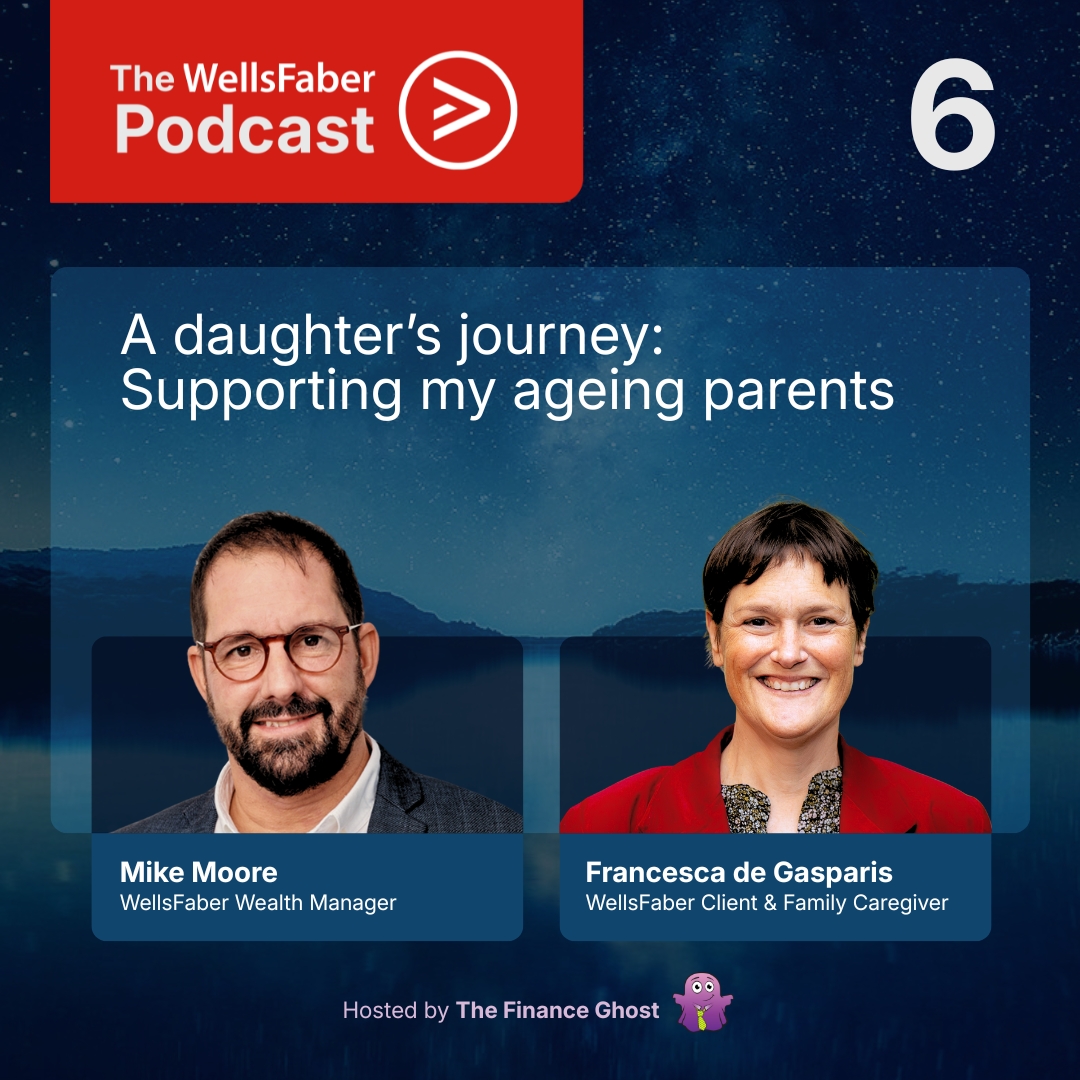
We aren't shy to dig into the tough stuff on this podcast. That much is clear. And I think that will be the case in this podcast as well, where WellsFaber client Francesca de Gasparis has graciously agreed to share her story about her experiences with her frail mom, moving her into a garden cottage, and just dealing with a lot of the adulting stuff that comes with having aging parents.
Very much real-world stuff. Affects your life, affects your financial plan, affects a whole bunch of things, I would think, as we'll learn from Francesca.
And to give us lots of additional insights based on what clients are dealing with every day, we have the familiar voice of Mike Moore from WellsFaber. So, Mike, familiar. Francesca, welcome, and I'm looking forward to dealing with real world stuff once again. As I said, that's what we do here.
Let’s start with you, Mike. What made you want to cover this joyous topic? You always bring us such sunshine and rainbows. If we're not talking about finances post-divorce, we're talking about inflation, we’re talking about frail parents.
You're going to have to bring us some rainbow sprinkles at some point. But I guess this is the stuff that really matters, isn't it?
Mike Moore: Absolutely. You know, on the podcast, we like to deal with the tough, emotional stuff. It's part of our job. It’s easy to talk about returns and the gold price going up and all of that good stuff, but actually the journey is multifaceted, so we like to cover that.
This is a topic that touches everyone, because whether you're the child or the parent, we're going to get old. And one of the toughest decisions that I find that clients make or grapple with, is how to deal with their old age and their finances.
Largely because one minute you are totally in control, and the next, gradually, you become (not everybody) … it becomes more challenging to be in control. And there's two parts to the equation. There's the elderly parent, and then there's the children. And very often, at some point, the children provide some level of support to their parents.
And so, it's a topic that affects us all. And I also think it's a topic that's difficult to have a discussion with if you're a parent to have with your children, or as a child, to have with your parents.
I thought perhaps having a third party like Francesca, who's been through the thick of it, it's nice to hear from them and get another perspective, and maybe it will give our clients or people listening to the podcast some motivation to take some proactive steps in dealing with the inevitable.
The Finance Ghost: Yeah, absolutely. I mean, I joke about the rainbows and sprinkles, but the reality is that adulting is not just that. In fact, there's not a lot of that. Let's be honest. You've got to deal with a lot of things as you get older and it's very good that we're giving people these resources to actually just make it a bit easier.
So, Francesca, over to you, star of our show here. Maybe just give us the backstory here around your parents and perhaps any early warning signs that you had that maybe they weren't coping as well as they used to anymore.
Francesca de Gasparis: Thanks, Ghost and Mike. Yeah, my parents were living in Johannesburg, which was my childhood home. My partner and I live in Cape Town.
So, my mom originally was the finance person in the household. My dad was never really like that much of a finance guy, but my mom got really unwell in 2014, and my dad became her main carer and looking after all the household finances, which wasn't his normal forte.
He asked us to help him with big debts he was incurring from water, lights, and electricity. And he was getting himself into massive debt. And it became a real jumble to try and untangle. And that was the early warning sign where we started stepping in.
My partner actually did most of that and that made it easier because, as one of their children, finances are a bit tricky. So as their daughter, I preferred it that my partner became the lead on dealing with the issues that they were dealing with.
It became quite complex, actually, the problems they were having. Going into stuff like Joburg… taking cash to reconnect electricity, but it wasn't actually formally part of the council. So, then they'd get their electricity cut again.
And Andrea would be saying to my dad, “But why is your electricity cut again?” And he's like, “I gave them R6,000 cash last week”. So, there was some kind of weird cartel thing going on as well, of course, taking advantage of elderly people.
The Finance Ghost: I was going to joke. When you said they live in Joburg, I was going to say, “well, that's the first challenge”. And then it proved exactly that. The stereotype… it's there. It's a stereotype for a reason. It's actually kind of incredible. I'm very sorry that they had to deal with some of these things.
It's stressful at any age, but I think it becomes utterly terrifying later on in life, particularly when you might not necessarily be earning anymore, or wherever they were in their journey, you start handing out these sums of cash you haven't budgeted for. You don't understand what's happening to you. Scary stuff to think about, actually.
One of my favourite quips is that Ernest Hemingway point around bankruptcy, right? And how it happens gradually and then suddenly. And I think this onset of decline and aging is like that as well, right? It happens slowly and then suddenly it doesn't. You reach that cliff. It's there.
Perhaps you can just talk us through the “gradually” phase. What did you start to see after that? So, yes, there were early warning signs, but a lot of that is still, if I can call it, very normal. We all have things with our parents. When did you start to see the decline really kick in?
Francesca de Gasparis: During COVID, they were really isolated from us, and we couldn't go and visit them. My dad started buying groceries for everyone in the household. My mom had carers that were live-in, as well as the domestic help and the gardener.
And he did that to try and keep them COVID safe. But his grocery bill absolutely just went through the roof. Then next thing, he was paying for my mom's carer's child's education. They really started being taken advantage of. My dad was a very generous person, and he was really vulnerable to that.
And there were other instances, too. A property that my mom owned, the guy was really harassing them. Their finances just started tumbling out of control. Monthly costs were just way too high, and Andrea stepped in to help him with a budget. He pushed back.
And so, it wasn't always very easy, because now they're losing their independence. We're looking into how they're spending money. I think they found that quite difficult. My mom didn't really care by that point. But my dad was, like, wanting his independence.
He was an amazing leader in his life and in his career. And I think having us step in like that did cause some conflict between us. But we really tried at all times to let them keep their autonomy. Let them make the decisions but present the information as factually as possible. And I think that's something that's really important for other people going through this.
As much as you have your own issues as their children, which you do need to bring up with them about fairness and reasonableness and all the rest of it, I also think that it's really important that you try, when it's their finances, to remember that it's theirs. And they actually get to say what happens, even if you disagree.
We had to wear two hats almost. And luckily that was my partner doing a lot of the actual straight finance-y stuff. And we actually brought Mike in round that time to start helping us. How do we deal with this? How do we consolidate?
My parents did no planning for old age. They refused to go to old age homes. They refused to have a plan for their elderly hood. And when they started not being able to do it, my dad's attitude was like, “Well, I'll just die, of course”. You know, there's actually something in between. We don't just all live from one day to the next.
The Finance Ghost: I'm laughing because that's going to be my dad. 100%. 100%. That is going to be it. It's like, “Well, then I'll just die. Yeah, feed me to the hyenas in the Kruger Park.”
Francesca de Gasparis: Exactly [Laughs]. And maybe that's why we have parents like that, Ghost. Because we're those people who want to plan ahead and want to have a plan.
And so, we really started to intervene more and more once COVID was no longer ongoing. We were going up more and more (to Joburg) just trying to have the conversation with them. They had a property next door to Kruger. They needed to consolidate that. Your money's not going to last. How do we make this work?
The Finance Ghost: Yeah, absolutely. And it's funny hey, you hear these things, “he was a leader in his field, they had other properties”. Clearly there's some balance sheet there.
But it's amazing how, without the right controls in place, that can go. And unfortunately, people do take advantage, and people who are generous by nature are even easier to take advantage of. I'm terrified that's going to be me in my old age. I'm listening to this, and I'm thinking, now, that already happens to me, literally alone when I'm old.
I mean, I'm 38 now, so I don't know what chance my kids have with me when I'm old. But that's their problem 40 years down the line.
Mike, this is a common issue, right? I mean, you obviously got involved at around this point. You do always seem to get very involved in just helping your clients. Just as an aside. I mean, that's been something that's come through.
Either you've really only helped, like, three or four people a lot, and they always come on podcasts, and it just makes you look really good, or this is your nature. I think it's the latter. I think you do tend to jump in and just help people with these complicated problems, right?
Mike Moore: Absolutely. I've known Francesca for a long time. I knew her parents. I do want to say they’re both formidable people. They were leaders in their field. So, it was a tough period over which we had to massage the situation to be able to best support them.
But I think one of the key moments was when Francesca's dad was willing to give Francesca's partner power of attorney, which is the key document that you need in order to take the pressure off your parents and start being able to act on their behalf.
And so, once we got that in place, we went through a process of gathering all their documentation. They had lived overseas; they had investments in every corner of the house. There were all sorts of things.
And also, you've got to understand that a power of attorney doesn't necessarily work for the bank. Standard Bank will want a different power of attorney to Nedbank will want a different power of attorney to a platform, to a unit trust company. So, it's not that simple. But once we had a power of attorney, we could start putting the picture together and consolidating investments, optimising them, making them administratively easier to deal with, and get a sense of the bigger picture.
Also, I often raise this with you, Ghost, is the complexity issue. The executive functioning, the willingness to deal with the admin disappears. It's just normal.
Francesca's folks had two other properties; plus the property they owned had a garden cottage with tenants in it. It was an old house in Joburg. It required a lot of maintenance, a lot of upkeep.
So, we decided to have a tough discussion because they'd had their holiday home in the Kruger for years. You know, we had to sell that. We needed the cash. We didn't want the admin around that. There was another investment property which hadn't been dealt with properly for a while, so we had to deal with that.
So, there was a process to getting everything organised. But once we had everything organised, at least there was a base from which we could make decisions and keep things moving going forward.
The Finance Ghost: Yeah, no one likes to face getting old and no one likes to face loss of independence and having to let go of things. It's very, very difficult. Childhood is about gaining things, and adulting is unfortunately largely about losing them, especially later in life.
It's not easy. So that's where this sort of expertise really helps, I think, with the emotional side of it.
So, speaking of the emotional side, Francesca, let's deal with the “suddenly” phase of the Hemingway quote. We've done the “gradually” - let's do the suddenly.
What was that turning point where it became clear to you that it was getting to that point now, where you were going to quite a significant intervention in their affairs?
Francesca de Gasparis: Yeah, thanks. There were a number of points which were really tough. I think one of the things that I would really advise people to do is to understand how they’re parents have got their money set up – even if they don’t understand.
Mike just reminded me of this sort of “forensic” process and the amount of time we had to put into it. I was fighting with a bank in Holland for years throughout COVID, trying to get a significant amount of money in. They said they won't allow international clients, and then I could not get the money out. The red tape is one of the major issues.
And when people need the money, you have to persist. And it's incredibly time consuming. But Mike was extremely helpful. But I would suggest, just even get the names of all your parents' brokers or whatever it is, once you're going to consolidate.
Because my parents definitely were proliferative. Yeah, shame. My dad then, after COVID, was well for a while, but then he got very unwell and he was hospitalised with a very aggressive form of cancer. And now their world was really falling apart because he was holding the fort together.
My mom is chronically unwell, so not able to do any of the household stuff. Not shopping, none of it. But there, and very much needing the support and love. And she’s a big member of our family.
But my dad was really, really unwell. And in fact, at one point, the doctor said to me he could just go, if he didn't treat this cancer. And we discovered before that point (but that had been one of the sticking points) that their wills weren't up to date.
So now that it had really hit the road, we had to get their wills up to date, while my dad, shame, was hospitalised. The legal team came there, and we made sure it was their will, what they wanted.
And I think that's again one of those critical things. When you've got siblings, do it properly. Don't do something on the back of an envelope or whatever, that won't hold and also can cause conflict with your siblings. You want your parents as much as possible to have a clean exit, as it were, and not leave too much detritus behind.
So, my dad was really unwell. We did his will. Then we needed to have all kinds of powers of attorney, including over the medical aid, which was in his name. And that was something that I had to sort out.
And these things, honestly, you'd think these big institutions were organised, but they're not. It's time consuming and difficult on all fronts. And so, my partner continued to be my parents' financial advocate. I was doing all the health stuff and emotional support.
And then my dad passed, about six months after he was diagnosed. So, it was pretty quick. And there was absolutely no way my mom was going to be able to live in that house in Joburg on her own. And there was no way we were moving to Joburg.
So, we moved her lock, stock and barrel, two dogs and one of her carers, down to Cape Town. It was phenomenal that her carer came with her. She's actually moved her whole family down here. But we were just very lucky that she wanted to do that. And it gave my mom the kind of support that she needed.
But it was a very, very rocky first year for my mom after my dad had gone. A very, very difficult move; not something she ever wanted. But my parents just wouldn't consider old age homes or anything like that. It wasn't for them.
So, the option was the garden cottage. And luckily, we had a little cottage on our property that we could convert for them to be wheelchair friendly. So that's where she's still living to this day.
Lots more ups and downs and other financial things to get sorted, including selling a house in Joburg during that terrible financial time that it's been.
The Finance Ghost: So, yeah, there's a lot there. This is how it ends up going, right?
And Mike, as I listen to all of that and try and imagine myself going through that admin, which is not fun at all now. And I am sorry for your loss, Francesca, of your dad.
Mike, as you listen to that, I'm hearing stuff like having investments consolidated, knowing where they are, wills, clean exit (Francesca's wording there), avoiding fights with siblings. There's a lot there.
And from your side, Mike, what would you want to just highlight there as being just good practice to try and make that really hard thing a lot easier?
Mike Moore: Listen, this is in an ideal world. Remember, you're dealing with people and there's all sorts of dynamics at play and we see them all.
The best outcome is to engage with your children early, get them involved, be transparent, and let them know how your finances are. You're going to have to get past any potential embarrassment or whatever your emotional concerns are around having these discussions with your children.
If you don't have the discussion early and upfront, when everybody is capable of having it around what investments you have, how you'd like your later years to be, then it becomes a crisis, and the burden on the children is quite heavy. And then the burden on the children becomes the burden on the child that is closest to the parents in terms of geography.
And that too, no matter how well your siblings get on, it does cause an element of conflict. Because somebody is sitting overseas saying, “Just keep me posted”. Meanwhile, the other sibling down here is sweating it out every day, having to leave work to sort out some issue.
So, I actually think being transparent with your kids, letting them know what your situation is, explaining to them what your preferences are, maybe getting a power of attorney in order now, setting up your will and saying, “this child is going to be the executor for these reasons, but I want you all to know what's going on”, is really helpful.
I've had a situation now, where a great family, with the father now 90, the one sibling's in Europe and the one sibling's here. The sibling here is the executor and has the power of attorney. And the other sibling phoned me out of the blue the other day to tell me that she'd like to know what's going on, because she hasn't been included.
And I don't think it's because of any malice on anybody's behalf. It's just that it's got to the point where one person's dealing with it, and the other sibling feels they're out the loop. So, I think you can avoid a lot of this type of conflict by dealing with it early and dealing with it transparently.
Francesca de Gasparis: And bringing in a Mike. Having someone like Mike really makes a difference because it took my parents a little bit of time to trust Mike, but because we trusted him, that really helped them to trust him too.
And then he could, even when they weren't really that interested, have the conversations with them that needed to be had. It was a team effort, honestly, and we all played our part. But to have someone independent really helps.
Also, independent executors of the will. I know Mike said “one of the siblings”, but also not having one of us do it does also help. I am not executor but let me say the burden on me has been really, really heavy.
My partner's been executor of my dad's will as well, and that's only just been wrapped up, over three years later. It took so long. There are so many funny things like vehicles and trailers. There are so many things that just can take forever.
The more people can do to prepare, and including people like my and Mike's age, you know, we're in our 50s and this is like a real good warning for me to get my house in order because I'm not organised either. So, I feel like I've gone through the pain with my parents, and I don't wish it on anyone.
The Finance Ghost: It is really interesting and like you say, Francesca, it is quite the wake-up call. These podcasts are actually always a wake-up call for me, just on everything that we always are talking about, ranging from health through to planning some of these things. Thinking about parents, it's not easy stuff and I think the earlier you do it, the better.
Mike there is something that seems to come through quite often though. And maybe I just want to touch on this in terms of what your clients see and what your advice often is. And that's around property ownership.
And I think particularly the generation who need to be thinking about wills and who are, let's call a spade a spade, who are passing away now, etc. Property ownership was an enormous part of how they built wealth, right?
It was the classic advice is you buy your first apartment; you never sell it. You buy your second one, you rent the first one, then you rent that out and by the time you're gone, you probably don't necessarily have a big portfolio of listed stocks, that are sitting on a platform. It's easy to see what they are, and you sell them with the click of a button. They've got three properties, one holiday home.
My generation, and I'm 38 now, is not doing that. Those younger than me are definitely not doing that. But that older generation, that's how they created wealth. So that obviously creates another whole layer of complexity, right? Because property is probably not what you want to be owning in your latter years with all the headaches that it brings, right?
Mike Moore: I would agree. You can't tell a “dyed in the wool” property person this. But the thing is, you can borrow against property, and your rental income pays off the loan. You can't really do that with shares.
So, I think that's the natural ‘go to’. You can start feeling like you've got some materiality in terms of assets. Obviously, the more equity you build in the property or the more the price goes up, you can borrow a bit more and buy a second one. So, I think that's the appeal to is it kind of gets you going in a sense and the borrowing helps a lot. And sure, it does work.
But you know, property is… just think about England and Joburg. They were the two fantastic places to own property, specifically England. Now, it's very difficult to sell a house in the UK, and we know what's happened to Joburg property. This isn't about investments.
But the point is, once you're locked into a property, if it turns, it's difficult to sell. Secondly, places change, tenants change, there's admin around getting your rental income in. Thirdly, you need to manage them, in terms of maintenance.
So yes, while you're young and active and capable, it can be a part of your portfolio for sure. But from an admin perspective, as one gets older, I don't know, you set up a company and you bought property together with your mate or a partner, the admin does become complex.
Often we've landed up selling these type of things, unwinding them for clients in their 80s - 70s or 80s. And then if you're taking a property that's jointly owned with a mate and it's being inherited by three of your children, you can imagine it's messy. And notwithstanding the fact if you have property overseas, you've now got the local jurisdiction to deal with.
So, I think property is great, it's got its place, but certainly from an admin perspective in older age, you don't want too much of it because it does tend to create complexity where it's unnecessary.
The Finance Ghost: Yeah. The right test here is probably, you know what the headaches are in your life and you have all of the context to those headaches. When you're gone, your kids or whoever are going to have to mop up those headaches without the context, which is just going to make them 10 times harder.
So, if there's stuff that keeps you up at night or irritates you, it's only going to be much worse for someone you love when you're gone. And I don't think it's possible to take all of it out of your life.
But I think if there's obvious stuff, Mike, you've raised an absolute killer example there. Owning property in a company with other people and then kids are going to inherit that. I mean, that is an invitation to disaster. I can well imagine how that goes. Just don't do it. Just don't leave yourself in that situation.
Maybe as we start to bring this to a close, then, Francesca, perhaps you can, especially because it's been quite a heavy topic, maybe give us an idea of life these days. Is there light at the end of this tunnel? Is your mom doing well? Everything kind of feel like it's together now at least?
Francesca de Gasparis: My mom's… Obviously, we have to keep watching her finances. As you said, it's finite and she needs a lot of care. But yeah, she settled in well. She goes through ups and downs, but she's doing good.
Obviously, for her, life in Joburg and life with my dad is the thing she still misses tremendously every day. But she's really comfortable and we've got through the really difficult finance aspect of it.
And we can spend more time with her just appreciating and enjoying and not scratching our heads over how are we going to solve this financial nightmare that my parents have left undone. There were a lot of them. I mean, we haven't even covered all of them today.
But they were smart financially. Let me just say they were super smart financially. They had savings, they were fine. And she's still able to live off what they had and their investments and so on. But they didn't plan for this stage.
And I guess it's a really hard thing to do for all of us to think about when I'm not there anymore.
But I also think it's like a wonderful thing if you do it right. You can really leave a great legacy. Give to who you want to give to. It's actually kind of a final message to the world.
I personally think we shouldn't be scared of doing our wills. I guess it's admin, and some of us really don't like admin. The moral of the story is: it doesn't go away [laughs].
The Finance Ghost: No, it doesn't go away. Mike, maybe bring us to a close here just around advice. A lot of it's come through already, but maybe just a couple of points that you would want to leave the listeners with that they need to be thinking about.
A lot of the listeners to this podcast and WellsFaber clients will be people who need to be thinking about this stuff, and the state of play that they leave for their children when they are gone.
Mike Moore: Three things. We've said it already: start sooner rather than later because events can happen suddenly. Secondly, be transparent with everybody. Let all your children and your wife and whoever else needs to know, what you would like to happen or who you're giving authority to, to do what and why. Because there's usually logic behind it.
Thirdly, the role that I've played in this depends. Sometimes I'm just an administrator, a consolidator, an organiser. Sometimes I'm a planner of finances. Sometimes I'm giving advice around the best way to do things so that we can keep as much of the cash or the investments in the pot and not going to the exchequer.
And sometimes I'm just offering some moral support, because people are entering an uncertain world, or a place they're not used to. But I think having an independent person does help.
Francesca de Gasparis: For me, sometimes we felt it was like an emotional issue or a deeply personal issue, but actually Mike could navigate some of those things for us really well and help us understand it financially. People often mix - certainly in my family, finances and emotions or love or relationships, it was all jumbled up together.
So, Mike's actually really good at unpacking those things and helping us get a clear financial way forward that actually does make sure it's fair and reasonable, and in the best interest of the clients. Which wasn't always me, by the way!
I think it's really helpful to do that. And even my mom now, it's her money and it needs to be done the way she wants to do it. And Mike can give the kind of independent advice and support for us to make sure that happens.
The Finance Ghost: Mike, Francesca, thank you so much. I think you've given us a lot of amazing insight here, and so much real-world experience which is ultimately what this podcast is all about.
So, Francesca, well done on getting through all of this difficult stuff, and thank you for sharing your personal story with everyone on this podcast. It's a brave thing to do and it certainly helps other people, who are either planning for this phase or perhaps in it right now.
And Mike, of course, well done to you for just always being a rock for your clients. That always comes through in these conversations. It's about way more than just picking the S&P 500 or the Nasdaq. That's one thing I've learned from doing this podcast series with WellsFaber. It's way more real-world stuff than that. Well done and thank you to both of you.
Francesca de Gasparis: Thanks so much.
Mike Moore: Thanks, Ghost.
Francesca de Gasparis: Cheers.