Episode Transcript
The Finance Ghost: Welcome to this episode of the WellsFaber Podcast. I’m your host, the Finance Ghost. I'm excited to be doing this here today, and to bring you insights into a topic that we all know, and absolutely nobody loves, which is inflation!
And as someone who has a toddler sleeping in the room next door, who will hopefully remain asleep for the duration of this recording, if there's one thing I understand, it is inflationary pressure on costs.
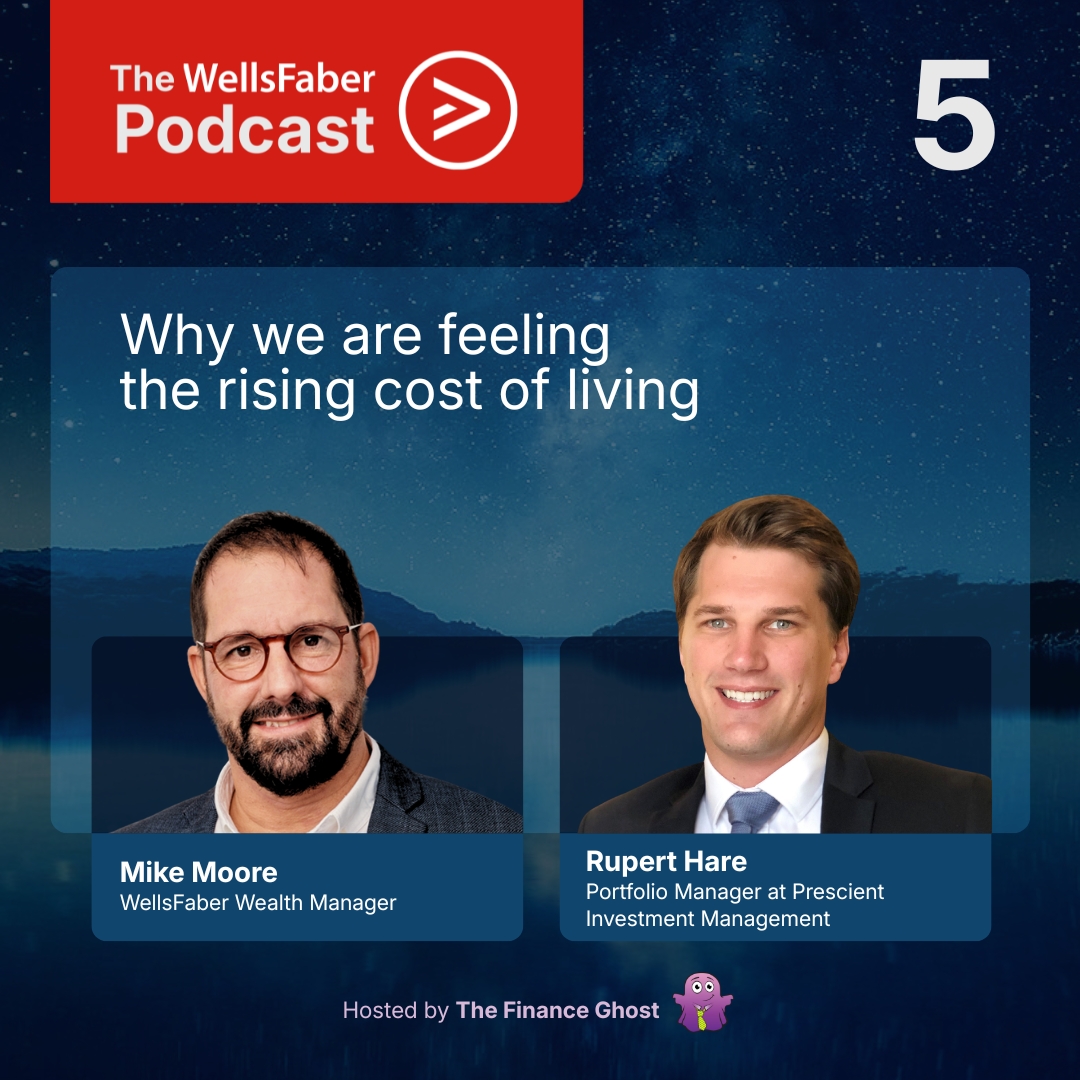
But I think we all have our version of inflation that we have to deal with, of course. Everyone spends money, everyone has to live. And Mike Moore, Wealth Advisor at WellsFaber, I guess that's why you said to me that we should cover this topic.
And you've called in the troops. Here we've got Rupert Hare, who's a fund manager at Prescient Investment Management. So it's going to be a good chat.
Mike, let me say hello to you first and then we'll formally welcome Rupert to the show. Hello, Mike!
Mike Moore: Ghost, lovely to be here. Thanks for the opportunity.
The Finance Ghost: Yes, let's have some fun, Mike. And Rupert, thank you for joining us from that very cool-looking studio there at the Prescient offices. You're looking nice and relaxed, which tells me that you've got inflation under control. Maybe, maybe not!
At the very least, you've got this podcast under control. So, thank you for joining us.
Rupert Hare: Yeah, no, thanks for having me.
The Finance Ghost: Mike, this man looks much too relaxed to be dealing with inflation.
Tell us why you want to cover this topic. Because what I'm hearing is, your clients are not so relaxed. It is not easy out there in terms of cost of living. Walk us through why this is an important topic.
Mike Moore: It's been an interesting six months in the land of financial advice, because, yes, we obviously see our clients on a regular basis. And those who are in retirement and drawing down on their savings draw a fixed amount, and from time to time they ask for an increase.
An increase in the income, an increase in the amount they draw down from their savings. But it's not like the textbooks. People don't typically increase their drawings every year in line with inflation.
They tend to get by and absorb the increases for a while, and then will say, “You know, Mike, I could do with an extra R5,000 a month. Can we afford it?”
But what myself and my colleagues have noticed, something different in the normal pattern, is that almost everybody that we go and talk to in the last six months or so, is requesting more money.
And so it is an unusual time. And what struck me is that when I read the news, I read that inflation is at a 21-year low of 3.5%. So I wonder, why are my clients requesting all of this? I don't live their lives, I don't have their basket. But I think they probably are wondering the same thing.
So I thought it would be a good topic to cover, and explain a little bit more about the current circumstances, and how we deal with these things.
The Finance Ghost: Inflation is a very complicated thing. I recently did a podcast with the CEO of Shoprite, and what's been fascinating there is that they've been in a deflationary environment in some of their food items. Which might come as a surprise to people who get to the till and have a look at what they're spending, and they get a big fright.
And then I follow listed property companies, and they go and sign leases that give them a 6% a year increase every year in the rent. And they say, “Well, we need this to cover municipal costs and everything else”.
Inflation is clearly a reasonably complicated thing. That basket might have a particular percentage, but that doesn't mean that's how much your expenses are going up by.
So Mike, I'm going to stick with you for a moment before we go across to Rupert. Your clients are asking you for more money. Clearly this is for a reason, but anecdotally, what are they telling you? What are they struggling with the most? What are the real pressure points?
Mike Moore: Please bear in mind that we've got a lot of different clients. For some people, absorbing the cost of living increase isn't an issue. So this obviously deals with a certain type of client that hasn't got an infinite amount of money. But typically, the type of stories that I hear are things like “I went to Woolworths the other day and bought two bags of food and it cost me R1,000”. So that's a common complaint at the till - how surprised people are at those costs.
Electricity comes up regularly. Everybody loves bashing the medical aids and having a complaint about the rate at which they increase their costs. Post-COVID increases were brutal, and they’re typically high. So anecdotally I hear that.
And more and more, we're also hearing a lot of concern about the valuations the municipality is putting on people's homes, because the valuation links to the rates and taxes. So that's another thing that's coming up.
Those are the themes that are constantly there.
The Finance Ghost: Yeah, it's quite funny, you know your client is in Cape Town when they complain about the rates and taxes and the value of their house going up. And then you know your client is in Joburg when they complain about the value of their house going absolutely nowhere! This is how you can tell which city someone is actually in. It's fascinating.
Rupert, let's bring you in here. We're hearing that Mike's clients are struggling. There are certain pressure points there. They all make a lot of sense, in terms of where people have been spending their money.
Why is this their experience, when the headlines are telling us that this is the lowest rate of inflation we've seen in many, many years? Why is this still the reality then? What's going wrong?
Rupert Hare: The key to keep in mind is that inflation is custom to every person, and I think Mike was touching on that.
People have different types of expense groups, and the basket that calculates CPI itself is meant to be a representation of the whole of South Africa. Whether it's right or wrong, we can debate for hours. But the idea is that it's meant to be representative of the whole of South Africa.
Quite simply, the whole of South Africa doesn't shop at Woolies, right? So there might be an increase in Woolies food prices which is not experienced by the rest of South Africa.
There's also, I find, a lot of bias within the human mind towards what I would call “lifestyle inflation”. Mike's got interesting cases where people are actually towards the retirement or retired phase of their lives. But if you think about someone who's pre-retirement, they're spending more and more.
You mentioned your young child. If you didn't have a young child last year or the year before that, then you didn't have to spend money on an additional person in your house. Now all of a sudden when you go to Woolies you've got to buy more food.
So it's really hard with the human mind to just separate out when you're paying more for potentially more goods (or different goods), from when you're paying more for the same goods. And that's what Stats SA tries to separate out - to say that if you were to have been buying the basket of goods representative of the whole country, then in fact the latest price as at end Feb was 3% year-on-year inflation. Much, much lower than we have historically been used to.
The Finance Ghost: Of course the greatest joy of buying food at Woollies for your toddler is that they probably won't eat it anyway. That's a really bad form of inflation that I haven't seen in any Stats SA release whatsoever.
But yes, you're absolutely right. It is lifestyle costs. It's how things change. It's the squeeze on the working middle class in South Africa, right? You have to earn your salary, you have to pay for private services left and right.
This is why people are not having kids as much, or anymore, at all. It always shocks me every year when it's birthday party time, and I have to go through the list of my friends who actually have children. And it's very, very short. There's a very short list. It's mildly incredible, actually. Definitely a topic for a different day, but affordability is part of it.
So I'm going to stay with you on this one, Rupert. Just a look at the products or services that have really been the biggest pressure points in the last few years.
The one that comes to mind certainly, is electricity. I think everyone always talks about that. We've gone to a world now where people are doing solar, not because we don't have electricity, but because it actually saves us quite a lot of money.
But of course, there are others.
So where do you think those big pressure points have been, and are any of them likely to actually calm down? Or is it just going to keep going?
Rupert Hare: So the first point you have, on solar versus Eskom, is a classic example. Because, whereas you could have been a consumer of electricity from Eskom, which has gone up, I think, 40% over the last two or three years, there are now alternatives that you can switch towards that are a lot cheaper.
Necessity is the mother of invention, and it creates something else that you can switch to. For example, you could go from Woolies to Checkers to spend slightly less on your basket of goods.
I think the problem for South Africans is that the majority of our inflation over the last couple of years has been imported inflation. So it's something completely out of control for us.
We all know there's a pre-emptive notice of massive fuel price increases. That's a classic one. So, trouble in the Middle East, we import the majority of oil - in fact, I'd say 99.9% of oil is imported - and that means that we are subject to increases in the price of Brent Crude in dollars.
And we are also subject to increases in the ZAR/USD exchange rate. So ZAR/USD weakens. It's much more expensive to go on holiday to Disneyland, but it's also a lot more expensive to import things like oil or iPhones or computers, anything like that, into South Africa.
We are predominantly - aside from natural resources which we export to the rest of the world (things like iron ore and gold) - importers in South Africa. And that's where the consumer gets hurt the most.
The Finance Ghost: It's quite fascinating to follow it on the JSE, right? Because you have these big industrial companies who have been built around the export market. The rand always gets weaker and we don't get imported alternatives that are affordable.
And then suddenly we have a shift like we had before the conflict in Iran, where the rand was getting so much stronger. And suddenly I was reading reports on the market of how our big industrial firms are actually struggling, because exporting isn't as attractive anymore. And you've got cheap imports as a very nasty alternative.
There are lots of industries and companies that have been affected like that - sugar, Italtile, but many, many, many examples. And in the world of commerce, whether it’s strong rand or weak rand, people can manage.
But in terms of individuals, people who are retired or working, we want a strong rand on average. That's what we want to see. Because as you say, so much of our inflation is actually imported.
Mike, going back to you then. A strong rand is an unusual thing, unfortunately or fortunately, depending on whether or not you own an exporter. That means that people tend to need to increase their income over time.
So when that phone call comes, or that email, and says “Hello Mike, I still like Woolworths and I'd like to buy my food there, I want my organic potatoes” and goodness knows what else, what route do you take to try and protect that ability? And do you sometimes just have to send them in the direction of their local Checkers instead?
Mike Moore: It is a bit like that. It's so interesting. The beauty of this job is that you deal with such different people, and certainly the people in my parents’ age, or let's say the “post-war babies”, even if they have a lot of money, they still complain about the price of goods. Even if their kids are going to inherit massive amounts, they'll still chat to you about the cost of living and how expensive it is.
Whereas if there's a 50-year old wealthy chap, he’s more likely to just absorb the cost of living and crack on.
But there's two sides to the equation, isn't there?
If the cost of living is going up and the client asks for more money, it's simply a case of having a look at how much capital they do have, and what they can really afford to draw down each month or each year without depleting their capital during their lifetime. That's the key thing.
As a financial advisor, the last thing you want is to tell somebody that they’re drawing an income that will be with them for the rest of their life.
If you're sitting with a client that doesn't have the capacity to increase their income, then there's only one or two alternatives. They either absorb it and change their habits, or they don't change their habits, but they ask children or somebody to help them, which some will do.
Or, we've even been in situations where an elderly client who's still living in their home that they've had with their family - maybe a husband and wife looking at their capital depleting - the funny thing is, I've got clients in their 90s and perhaps they've got enough capital for another eight years. They know that they're under pressure from an expenses perspective. But even at the age of 90, it's quite a strange conversation to say, “Yes, according to the actuarial tables, you might not be here tomorrow”, but the reality is, they could be here for another eight, nine or 10 years.
So when you're sitting having a conversation with somebody like that saying, “How long am I going to live?”, the actuarial tables actually say, “Well, you shouldn't really be here, but when I look at you, you're looking great”. So we've got to actually really build in some fat for another eight to 10 years.
So the point is, in those circumstances, that individual may be living in their home that they had with their kids. So there is capital there. And it may be a question of ultimately selling the home, and using the capital to extend the affordability of their life, if you know what I mean.
In some cases it's selling the home, in some cases it's going from Woolies to Checkers. And in some cases, individuals can actually absorb the increase, and spend more money, even though they might not like to.
The Finance Ghost: You're forcing me to quote here, from one of my favorite ever movies, (which is The Dark Knight) and of course that famous line by Harvey Dent: “You either die a hero, or you live long enough to see yourself become the villain”.
That is basically a summary of retirement with high inflation, isn't it?
It’s like, “I really want to be here for a long time, but also, I'm going to run out of money.” Or, I might run out of money, or I might have to really change my lifestyle in a way I don't want to. These are just the realities.
Unfortunately, life is about constraints and sometimes it does require a change in habits, as you say. I feel like it's also that old story of, “If you're going to panic, panic early”.
Surely it's better to actually try and get on top of this, right? I imagine those are a lot of the conversations you have with your clients. Don't wait until it's a catastrophe. Rather make small incremental changes and get on top of this then, right?
Mike Moore: That’s it. People have pride, people have shame. And really, from an advice perspective, you want to bring them out of that and say, “Listen, plenty of people are in these situations, it's not just you”.
I think a big part of what we do is try to get people to face up to reality, accept it for what it is and make a plan. Hope is not a strategy; a plan is a strategy. And if you're engaged with the financial advisor, you can have those discussions and hopefully head off any major issues before they appear.
The Finance Ghost: The power of gratitude, hey - lots of people dream of buying food at Checkers, nevermind Woolworths. So sometimes you’ve got to also get some context there - and remember where you are in the world.
Rupert, let's bring it back to you then, because ultimately the way you work with Mike is that you are a fund manager - Mike is putting client money into your funds, which means that your job is to help protect and grow their life savings. To try and beat inflation is surely the first and most basic hurdle.
Let's just spend a few minutes on that while we have you around. Your approach here: how do you actually aim to do that?
Let's try and keep it as accessible as possible. I have no doubt we could wax lyrical for eight hours about the intricacies of what's in your portfolio, but I think let’s keep it very much a high level chat here just to explain to people how you actually keep them on the right side of inflation.
Rupert Hare: High level is, for us, the key. So that's how we actually run money. We don't focus nearly as much on the intricacies, and it sounds like we're ignoring the details, but it's really about the broader picture when it comes to structuring portfolios that align with client needs.
So what do I mean by client needs?
Two of our unit trusts that we run: one is a balanced fund, a high-equity product, and the other one is a defensive fund, a low equity product.
What are those two things for?
The one is for a client that can take more risk, and this is all about client risk objectives. One is for a client that can take more risk and has a longer-term horizon. And the other one is for a client that can afford to take more risk and has a shorter term horizon.
They're all designed to beat inflation, that's the first thing. So if you think about a client's objective, you have to outperform inflation. I say that with emphasis. But at the same time, you can't just outperform inflation because if you outperform inflation by 1% (for argument's sake), you're just protecting your capital.
You need to be able to outperform inflation to protect your capital, and then also to outperform it by a significant amount - such that you can spend that capital.
What we do in our balance fund is target CPI + 6%, so a 6% buffer over and above inflation, which over the long term gives you that buffer so that you can protect your capital, and at the same time you have a bit more money to grow and to spend.
How do we do that? Well, we allocate towards a mix of growth assets and defensive assets. And those asset classes range from equities, bonds, property, cash, onshore, offshore.
You name it, multi-asset can invest in it.
And our job is to try and maximise the likelihood of clients getting to those long term objectives. And it sounds a lot less exciting than a lot of asset managers might talk about. They might tell you about how Pick n Pay is the next best opportunity in investments, after Checkers. But for us, the most important thing is, how do we get you to that CPI + 6% through the cycle?
And the second part around it, and this is primarily Mike's role, is that when a portfolio doesn't give you CPI + 6% on a one year basis, it's about educating the end investor to say, “Well this is a longer term growth-type portfolio, you have to take those risks in order to achieve CPI + 6% over the longer term”. So longer term being five years and beyond, you have to have the patience.
But really, there are two “free lunches” in asset management. The one free lunch is diversification, so spreading your bets as much as you can. And the second free lunch is time - you get paid for spending time in the market.
And that's really important for some investors who will say, “Well, I've got the best opportunity to withdraw and buy a new holiday house. It's a great opportunity to buy a new house in Hermanus. It can only go up from here”. That's a pretty risky bet if you've got limited capital.
Rather structure your portfolio so that it's aligned with your own needs in the long term cycle, target your CPI + 6% through the asset classes that will pay you that, and be aware of the risks in the shorter term.
The Finance Ghost: You talked about balanced funds there, which is something that WellsFaber clients will surely have seen on some of their statements over the years.
And maybe it's a good opportunity, while we have you, to understand more about what a balanced fund actually is. Because I think people hear this term, but they don't always get it.
I guess the right analogy now might be, it's great if you want to have the fancy cake from Woolworths, but if you eat only that, you're going to have a bad time. Balanced funds, like balanced eating, are about making sure you've got the right mix of everything, right? A little bit of excitement, a little bit of sugar, but not too much, right? That's probably not a bad analogy for the world of balanced funds.
Rupert Hare: That's exactly right. It's a balanced diet, quite literally.
South Africa has a history of (in asset management) coming from a more equity-centric space. So you literally just eat sugar, and that's very exciting until you crash about half an hour later. And it comes with a significant amount of volatility, risk within the portfolio.
And clients don't realise that risk is something which, when it comes to stress, is the direct driver of stress. So when it comes to a balanced fund, we try and diversify away those concentrated risk aspects.
So instead of just buying single stocks or stocks in the SA stock market, instead of just buying your Pick n Pay, we rather buy a mix. So Pick n Pay, Checkers, Woolworths - and so it goes into the Marks and Spencer, or the Waitrose. We try to go global as well, to extend the analogy.
We know that (call me a bit of a pessimist) one of those stocks will probably fail in the next five to 10 years. So if you pick one of them, then you are at significant risk as an investor. But spread your bets across them and you get a much more balanced approach in a balanced-type fund.
And that goes beyond just stocks. It's also, as I said, into the bonds market. And very important for me, something I'm quite passionate about, is not just investing in South African assets, because you don't have to. You can invest a significant portion of your money offshore.
It's not to say that South Africa isn't a fantastic market. We actually get paid quite a nice premium for investing in South African asset classes.
But we know that South Africa is one government, one central bank. It's one environment - and that's risk that you don't want to be concentrated in your exposures towards.
So if you can diversify across the world, across different geographies, be it China, the United States, Europe, the Middle East at the moment. If you invest across all of those different markets, you get what we call diversification, which is, as I said, one of only two free lunches in asset management.
The Finance Ghost: So Rupert, you've talked about that sugar diet that South Africans have been too accustomed to with equities. Yes, I completely get that. And unfortunately, it's like anything: sometimes you do just have a bad dessert, which is terrible because you expect it to be good. Using up that sugar allocation, and then it still sucks!
And that's where diversification is so important. Because for years that was unfortunately the story of the South African equity market. 2025 was wonderful. But go and draw a long-term chart and you'll see that there have been periods where you could have gone sideways, while people with offshore stocks were doing extremely well.
Again, diversification and time in the market, those are the things that pay you. Timing the market if you're lucky, or you're a trader, or you do it professionally or whatever - sure. But for 99% of people listening to this podcast, that's not where you are. You're looking to get proper long-term growth in excess of inflation, as you've highlighted there.
Mike, I'm going to give it back to you now. Because unfortunately, the risk is that you have a client who maybe doesn't take enough risk. The risk is not having risk, isn't it? Because you're not going to beat inflation by having the money under your mattress, are you?
Mike Moore: I'd just like to shine a light on this. I think there is a perception out there that if you invest your money, you’ve got a more risky sort of nature to you. There's something quite adventurous about going to invest your money and put it in Rupert’s balanced fund.
What I like about this conversation is that we've hopefully shown that it's not really an option not to have your money invested in something that's going to beat inflation.
Because if you're not keeping up with the cost of living or growing your capital or your savings, savings in excess of the rise in prices, then effectively you're getting poorer. Because this year you can afford two onions and next year you can afford one onion, because you haven't kept up with the price of onions.
So it is not unusual to hear somebody say to you, “I've got R5 million, I'm keeping R2 million safe on a fixed deposit, and I'm going to give you R3 million, but don't invest it aggressively. I'm very conservative”.
And then they watch the R3 million go up, beat inflation, but over the whole R5 million, they're beating inflation by a half percent or 1%. And to them, that's because they don't like taking risk.
But the reality is, they're taking massive risk because they're letting inflation eat up their money. So I think the message out there is, you have to beat inflation on all of your capital - and you need a mix of assets or investments, as Rupert's explained, to do that.
And the appropriate funds and fund manager will achieve that over time, with some ups and downs along the way, which is what people don't like. But that's part and parcel of keeping up with the cost of living. So that's a relevant point. I think a big risk is not taking risk.
The Finance Ghost: Absolutely. I love the fact you nearly called it “infleece-ion” there by accident, because that's what it does. It fleeces you of next year's onion! Maybe that's what we should call it, actually. It makes it easier to remember!
It's like anything in life, right? You can't wrap your body up in cotton wool and never live. And likewise, you can't do the same with your money, otherwise you are going to go backwards. I think that's the point, really.
That's what we've highlighted today: there are some big inflationary pressures out there. People experience them differently. It depends on your circumstances, your basket. But chances are very good, as a South African who has retirement savings and is listening to this podcast, you probably face an inflation basket that is higher than what's going on in CPI. That's just a reality, I would say, on average.
And that makes it very, very important to make sure that you are giving yourself a chance to actually get real returns (returns in excess of inflation).
Speak to people like Mike, who then make allocations to people like Rupert, who do their best to try and make sure that you can afford those onions in years to come. And maybe a little bit of chocolate cake from Woolies as well.
I think we'll probably leave it there.
Rupert, Mike, I wanted to thank you for your time today. This really is a very important message that you're getting out there, so well done.
And, Mike, I look forward to our next WellsFaber podcast, and who you choose to invite. It's always quite exciting to see what you come up with, so thank you. Rupert, thanks to you as well.
Mike Moore: Thanks, Ghost.
Rupert Hare: Thank you.
The Finance Ghost: Cool.